
The industry
Why the Richardson 112 is everywhere
The Richardson 112 shape is everywhere because buyers already understand it: a structured trucker, a stiff front for a small logo, mesh that photographs well, and a price both sides recognize. Stock it, and do not get stuck. The center seam and the mesh still have rules.
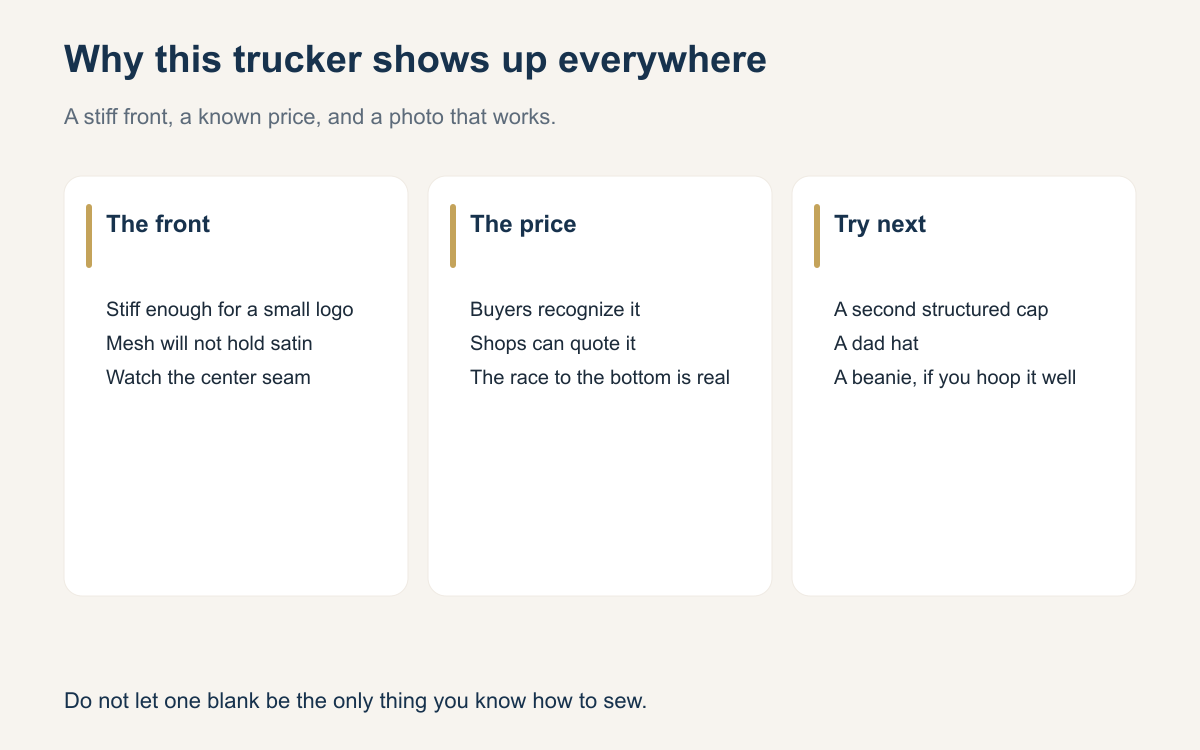
You have heard the request even when nobody says the number. A trucker, structured, mesh in the back, a front that holds a small mark. That is the family of the 112, and it is popular for boring reasons that happen to be good ones. People know the shape, shops can get it, and a short wordmark has a place to sit. It is still not the only blank you should own.
I am not going to invent a fiber content or a weight. If you need the spec, read the sheet for the lot on your shelf. What you can see without a spec is enough to sew and to sell: a structured front, a mesh back, and a center seam that will split a design that ignores it. Start there. Catalog language can wait.
Buyers already learned this shape
Teams, companies, and other shops taught the public this silhouette. You are not fighting the idea of the hat. A buyer can point at it, or describe it badly and still mean it. That saves a long talk about crowns and panels. When a blank is this familiar, the sale moves faster, and a faster sale matters when you are quoting between sew-outs.
Familiar also means compared. The buyer has seen the same hat with another logo at a tournament and at a hardware counter. They know it can look sharp, and they know when it looks crooked. You get credit for placement, stitch quality, and having the color. Stock it because the conversation is short. Do not stock only it.
A stiff front shows a small logo
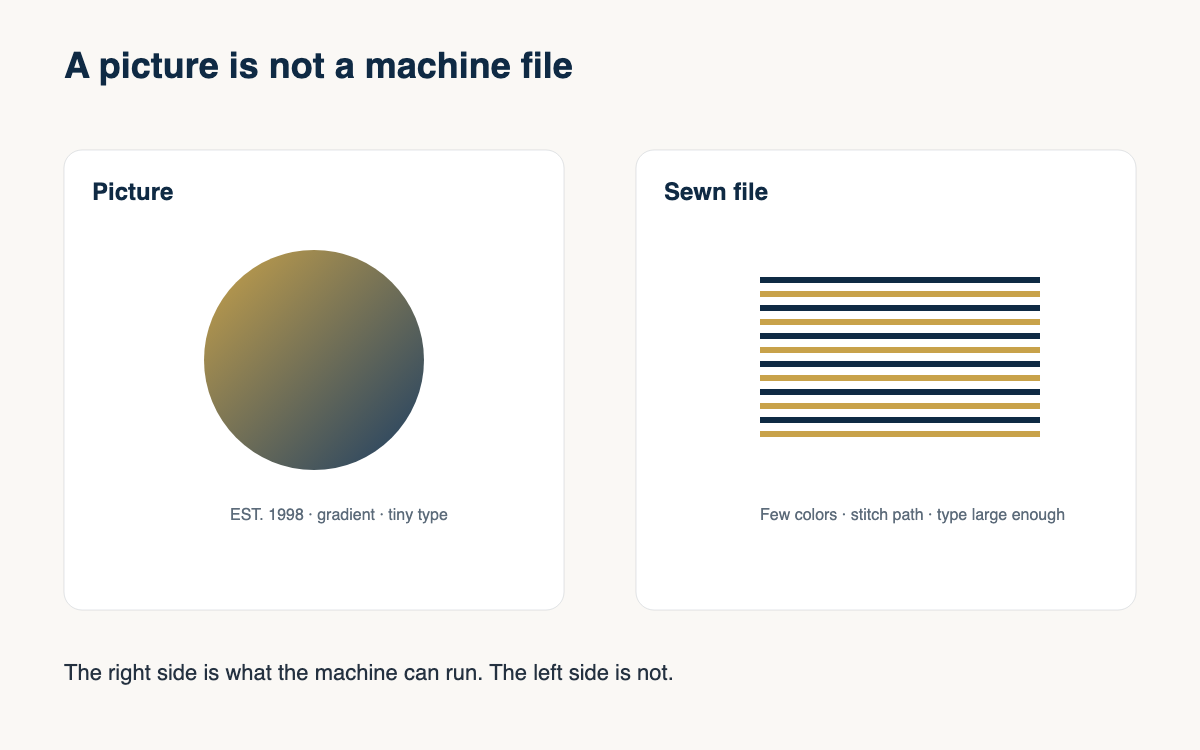
The front panel is structured, so a small logo has a fairly flat place to read. A left-front mark or a compact center mark sits up instead of sinking into a soft cap. That is why shops like this hat for wordmarks and little icons. The stiffness is doing part of the design work. Do not cover the panel with a fill so large that it stops behaving like a panel.
Keep the design in the area that is actually stable. A tall design climbs toward the top seam and the curve. A wide design heads for the seams on either side. In a product photo the front looks huge. In the hoop it is a short window. Sew your usual small logo and look at it on a head. If it reads at arm length, you are using the blank well.
Mesh photographs, and it will not hold satin
Mesh is why the hat looks light in photos and why people wear it outside. It reads as a trucker from across a field. A clean front mark and a visible mesh back tell the story without a paragraph. The photo is part of why this blank spread.
Mesh will not hold a satin fill. The sides and the back are for air, not for a crest. A customer who wants the big logo across the back of this hat is asking for a different blank. Say so before you hoop. If the design needs a solid fill, keep it on the front panel or move the job to a cap with a cloth back. Do not discover the limit during the sew-out.
The center seam is the catch
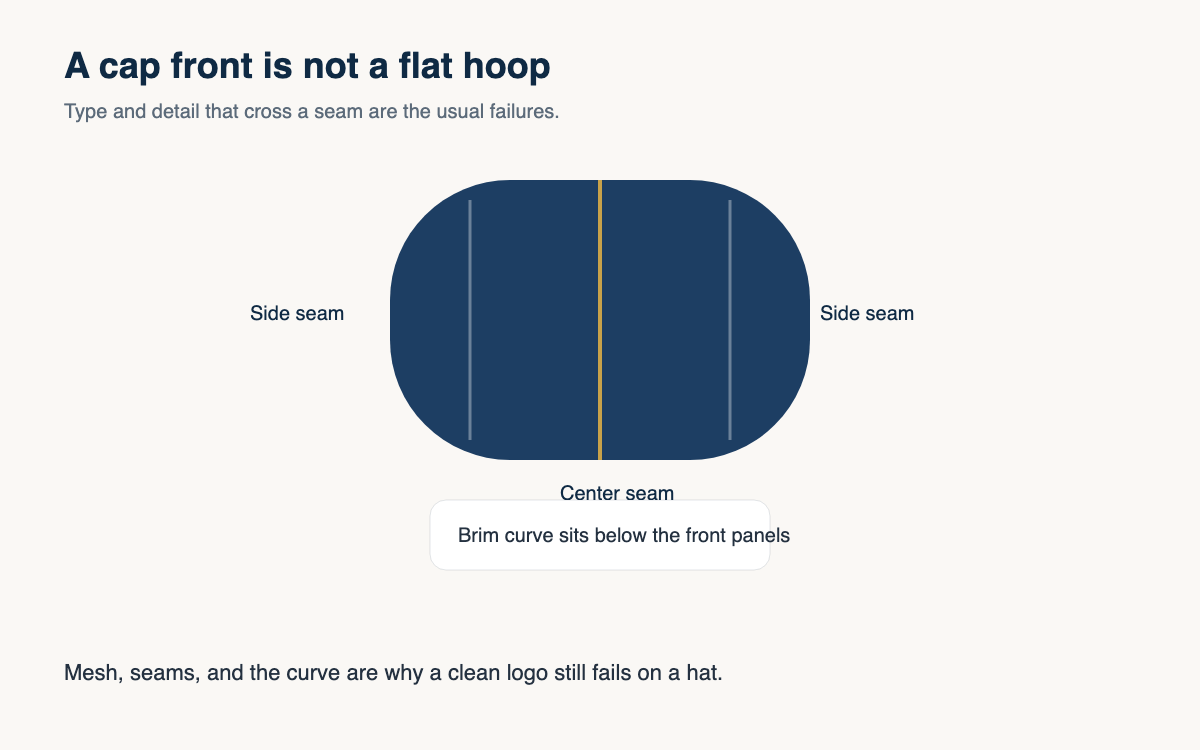
The front is panels, and the center seam is real. A wide satin that crosses it will split, gap, or look broken after the hat relaxes. Thin type on the seam is worse, because letters fall into the ditch. Place the design so it misses the seam, or build it so it does not depend on one satin column through the middle. Pretending the front is one smooth board is how a logo comes back looking cheap.
Show the seam when you show the art. A logo centered on a rectangle hides the problem. A photo of the cap, or a sentence that says the mark sits off the center seam, saves the argument. If they insist on a wide design across the seam, offer a smaller mark or another blank.
A price both sides already recognize
Shops know roughly what this hat costs to buy. Buyers have a sense of what a finished one should cost, even when that sense is a little low. A shared neighborhood of price makes quoting faster. You are not explaining a rare blank. You are explaining the sew. Put the blank cost next to the sew price and make sure the gap pays for cap-frame time. A famous hat is still a slower hoop than a shirt.
The danger is that a recognized price becomes a ceiling the town copies. If every shop posts the same number for a one-color front, you are in a race. The 112 is popular enough to cause that. The way out is a sew you will stand behind, a second blank, and the nerve to let a too-cheap order go. Familiar should help the quote, not set your wage.
Test other blanks so you are not stuck
Test alternatives so a backorder or a price fight cannot stop the shop. Another structured trucker with a similar front. A lower profile if buyers want less height. A cloth-back cap when someone wants a design the mesh cannot hold. A youth size if you sew for schools. Skip invented fiber claims. Sew your common small logo on each candidate and see whether you can reorder the color.
Do not drop the 112 because you are tired of seeing it. Drop the habit of having nothing else. A buyer who only knows one hat can still be offered a second shape with the same mark, and some of them will take it. The ones who will not are easy to serve if you still stock the familiar front. One blank you depend on is a supply line with a needle.
- Use the stiff front for a small mark that still reads at arm length.
- Keep designs off the center seam, or build the design so the seam is part of the plan.
- Do not put a satin fill on the mesh. Move that art to the front or to a cloth back.
- Read the maker sheet for fiber and weight instead of guessing a spec to sound precise.
- Sew a second structured style and a cloth-back option before a backorder forces you.
- Price the frame time. A familiar blank did not make the hoop faster.
The 112 style is easy to understand, easy to photograph, and kind to a small logo, right up to the seam and the mesh. Stock it when buyers ask for that shape. Learn the seam, refuse a satin fill on the mesh, and keep a second blank so one style is not the whole hat business.
A question for the group
Do you stock the 112 because it sews well for you, or because it is the only hat customers know how to ask for?