
The industry
Why some shops refuse customer-supplied items
Some shops sew every garment a customer brings. Some never do. The risks are a shirt you cannot replace, a stain that becomes your fault, a harder hoop, and a loss insurance or conscience will not swallow. The benefit is real too. Write the rule before the item is on the counter.
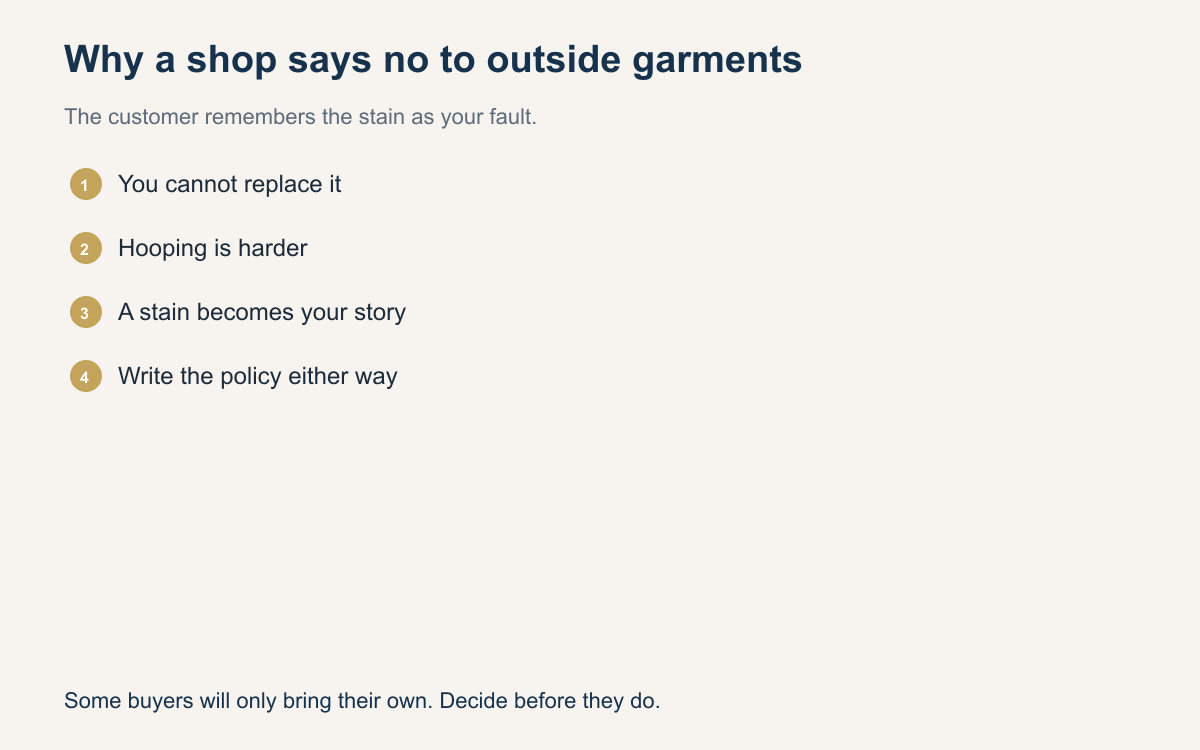
Customer-supplied goods look like easy money. The blank is already paid for and the logo is simple. Then the needle finds a hole you did not see, or a stain that was faint in the parking lot looks like you put it there. You cannot pull another one of those shirts off your shelf. There is no shelf. That risk arrives after you already said yes.
Refusing everything is also a choice with a cost. Some people will not buy a blank from you. They have a uniform vendor, a jacket that fits, or a stack of shirts from a tournament. If your rule is a flat no, that work goes to a shop with a different rule. A sloppy maybe is the lazy choice. The calm shops can read a policy out loud without inventing it at the counter.
You cannot replace what you ruin
When you sell the blank, a ruined sew is annoying and solvable. You grab another shirt and sew again. When the customer supplies the item, a ruined sew is a unique object. A tournament shirt from a year that is over. A jacket bought on a trip. A work shirt with a name already printed on the other side. You cannot reorder the memory. Money is a weak substitute.
Say that out loud before you hoop. If this tears, you cannot replace it. You can only refund the sew fee, and that fee is smaller than the item. Write it down. A nod is not a record. If they will not accept that limit, the job is a bad job, no matter how simple the logo looks on the phone.
The stain becomes your fault
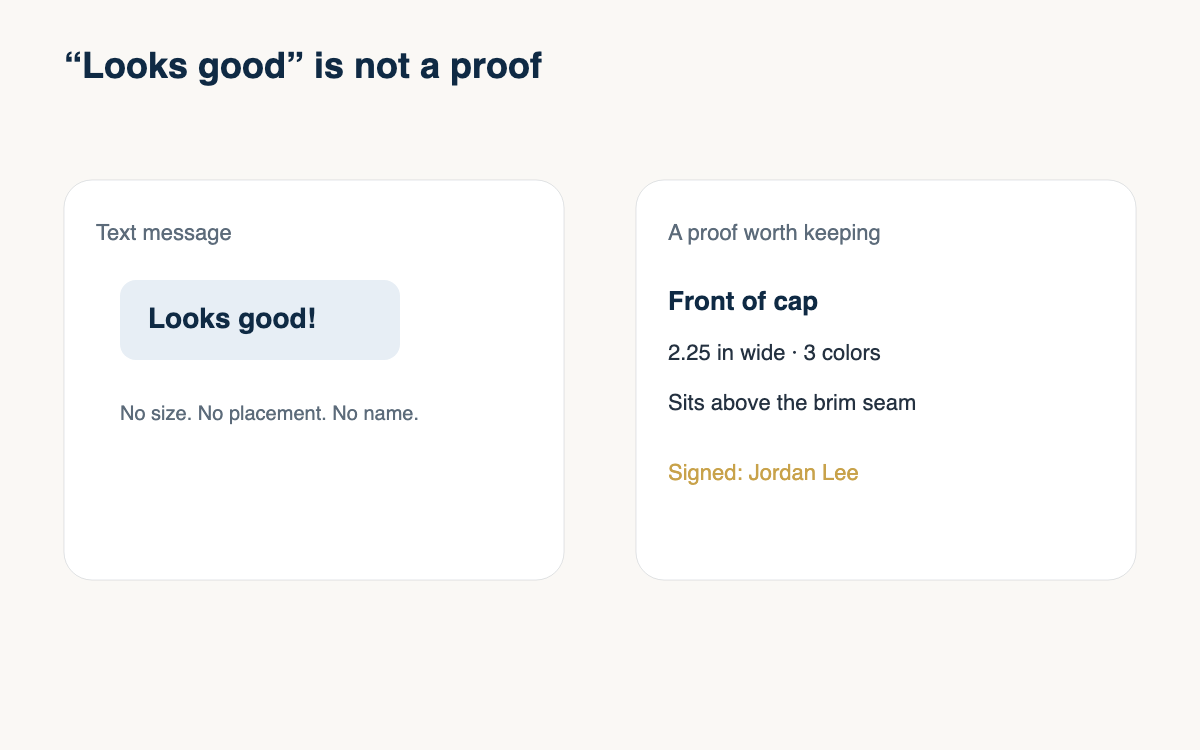
People forget the condition of a shirt the moment a logo appears. A faint spot near the hem becomes something you did. A small hole under the arm becomes the hoop. You will lose this argument on charm alone, because they hold the shirt and you hold an excuse. The customer remembers the stain as your fault even when you remember that it was already there.
Photograph every supplied item before it goes near a hoop. Front, back, and a close shot of any spot, pull, or thin place. Attach the photos to the order with the date. The photos will not win every fight. They win the ones where you can stay calm and point. If you will not take them, refuse the item. Do one or the other.
Hooping goods from someone else is harder
Your blanks were chosen because they hoop. A supplied garment is a stranger. It might be a performance knit with a coating that hates needles. It might have a print that melts under a rough hoop. It might be too small for the frame you own. The customer does not know any of this. They know the shirt fit in the morning.
Charge for the difficulty or do not take it. A supplied item that takes twice as long to hoop is not a favor you hide inside a normal sew price. Tell them the fee for outside goods, the fabrics you will not touch, and the placements you will not attempt. If they want a design across a zipper, the answer is no. If they want a tiny chest mark on a polo you would have sold anyway, the answer can be yes, with photos and a limit. Decide before the shirt is in the frame.
Insurance and conscience both get a vote
Ask your insurance what a ruined customer garment actually does to you, and read the answer. Some policies shrug at goods you did not sell. Some have a ceiling that would not cover a leather jacket. If you have never asked, you are guessing with the rent. The answer might be why you stop taking wedding dresses and vintage jerseys.
Conscience is the second vote, and it counts even when the policy would pay. A handmade quilt, a military uniform that is not yours to alter, a blanket for a child that is the only one. You can be allowed to sew it and still know you should not. The fee will not feel good if you damage it. You do not owe every request a needle.
Some customers will not buy your blank
Here is the benefit, and it is not small. A company may be required to use shirts from a vendor you do not carry. A team may already own the jackets. A regular may bring a hat they were given and simply want a side mark. If you refuse all of that, you are tidy and you are also smaller. Some of those jobs are regulars on a day they cannot start from your catalog. Turning them away forever is a real loss.
The middle path is a filter, not a mood. You accept outside goods when the fabric is one you know, the value is under a ceiling you chose, the placement is normal, and the photos are done. You refuse the rest without a speech. Customers can handle a clear no. They cannot handle a yes that turns into blame. Earn outside-goods work with a written limit.
Write the policy in both directions
Pick one and write it. We sew our blanks only. Or we accept outside goods under these rules. Put it where you quote, not only where you complain. A policy you are ashamed to send in a message is a policy you will break the first time a friend walks in. Make it plain enough that a new hire can say it on a Saturday without calling you.
Review it when you get burned, and change the rule instead of making a speech. Maybe you stop taking hats you did not sell after one structured cap with a hidden flaw. Maybe you raise the outside-goods fee after a week of terrible knits. The point is to decide on purpose. Shops that improvise are the ones who end up buying a stranger a replacement you cannot find.
- State whether you sew only your blanks or you accept outside goods.
- If you accept them, set a value ceiling and a list of fabrics you refuse.
- Photograph stains, holes, and thin spots before the item is hooped.
- Write that you cannot replace the item, and limit the refund to the sew fee.
- Charge extra when the hoop will take longer than a normal blank.
- Train the counter to read the rule. Do not invent a new rule per customer.
A supplied garment can be good work or a trap with a logo on it. You cannot replace it, the customer will remember every old stain as yours, and the hoop is harder than the blank you chose for a reason. Some customers will never buy from your shelf, and you can still serve them if the rule is written. Pick the rule this week.
A question for the group
Do you accept customer-supplied goods, and what is the one item you took that you would refuse today if it walked in again?