
Techniques
Why your embroidery thread keeps breaking
Thread breaks are often the needle, a burr, the path, the tension, the density, flagging fabric, or a dry cone. Check each of those before you blame the spool, and match the kind of break to the cause so you do not rethread the same problem.
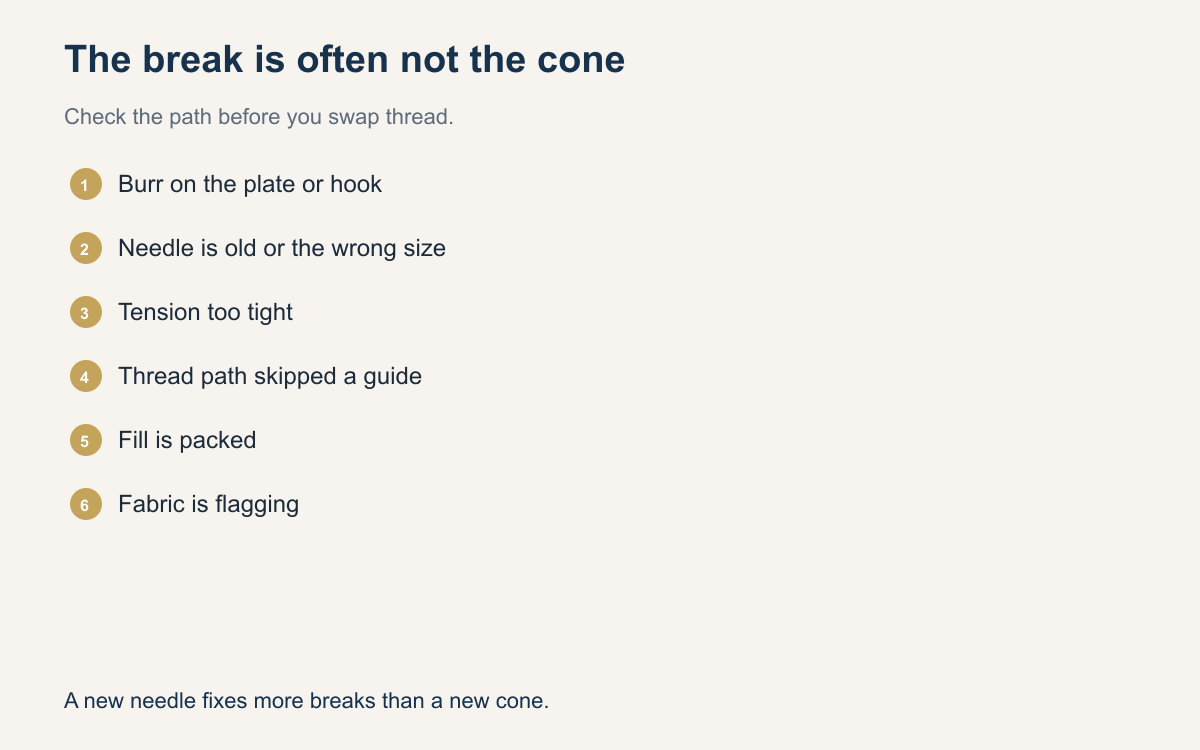
A break stops the machine, and the easy story is that the cone is bad. Sometimes the cone is bad. More often the thread is getting cut, pinched, or asked to sew a spot the needle cannot survive. If you swap cones and the break stays in the same place, you did not have a thread problem. You had a path, a burr, a needle, or a file problem that the new cone is now paying for.
Read the break before you rethread. A shred at the same stitch count, over and over, is not the same as a random snap in the middle of a run. The checks below are the order that saves time. Do them on the machine that broke, not on the story about the brand. Then sew a short test. If the test holds, go back to the order. If it snaps again, you skipped a step.
Burrs on the plate or the hook
A burr on the needle plate or on the hook slices thread with a clean little cut. The tail looks sheared, not fuzzy from tension, and the break often lands on a rhythm, like once every so many stitches, because the hook hits the same nick each revolution. Drag a scrap of the same thread across the plate hole and around the hook with the machine off and the needle up. If the thread snags, you have found the edge that is doing the cutting.
Polish a small nick if the part allows it, or replace the plate or the hook. A tougher cone only hides a burr for a few minutes. After you fix the metal, sew a test. If the rhythm break is gone, the cone was never the culprit.
The needle is old or wrong
A dull, bent, or wrong needle will shred thread and call it a bad cone. Needles are cheap compared with a stopped order. If the needle has sewn a long run, hit a seam, or been in the machine since yesterday and you cannot remember changing it, change it before you touch tension. Match the point to the fabric. A ballpoint is the usual choice on knits so you slip between fibers. A sharp point belongs on stable wovens. The wrong point punches, heats, and breaks thread.
Match the size to the thread. A small needle with a heavy thread, or a metallic thread in a tight eye, will saw the strand. A fuzzy tail at the needle means start there. Put in a new needle of the right size and sew a test before you touch tension.
Tension is pulling the strand apart
Top tension that is too tight snaps thread, especially on satin, where the strand is yanked side to side. The sew-out will look tight, the top thread may show on the back more than it should, and the break feels like a pop. Loosen the top a little and sew a test column. Do not spin the knob to hide a density problem or a burr. Tension is a small adjustment after the path is clean, not the first repair for every snap.
Bobbin tension can join in. A poorly wound or tight bobbin makes the top thread work harder, and you chase the top knob while the drag sits in the case. Seat the bobbin, clean the case, and judge a test from the back. Write the setting down only after this cone and this fabric look balanced.
The thread path is wrong
Rethreading fixes nothing if you follow the same wrong path. The strand has to sit in every guide, through the take-up, and in the tension discs. Open the discs the way your machine expects. A skipped take-up, a leaning cone, or a thread scraping the stand will fray the strand before the needle.
Watch one pull from the cone to the eye. The strand should come off with no scrape. If the break happens before the needle, fix the path and sew a test. Rethreading without looking just puts the same twist back in the guide.
Density and flagging
Too many stitches in one spot heat the needle and saw the thread. The break shows up in the same small shape every time you sew the file, often in a tiny letter, a dense corner, or a stack of colors on top of each other. That is the file. Open it, pull density down, or spread the pile of stitches. Changing cones will not open a column that is sewn shut. If you can point at the break on the design without looking at the machine, stop blaming the spool.
Flagging is the fabric bouncing with the needle until the thread snaps or nests. A loose float, a jumping knit, a torn backing, or a cap that is not seated will all do it. Secure the goods and add backing. A stable sandwich stops this break. A new cone does not.
Dry thread, then the cone
Thread dries out. Rayon in a dry room, an old cone that has lived on a peg for a year, and some specialty threads will break until you add a bit of lubricant or retire the cone. The tail looks frayed, the breaks feel random, and a fresh cone of the same brand may sew fine. If every check above is clean and only this cone fails, then you may blame the cone. Mark it, set it aside, and do not put it back on the machine for a rush job.
Run the checks so the cone is last. Burr and hook. Needle point and size. Tension on a test. Thread path from the stand to the eye. Density if the break is always in the same shape. Flagging if the fabric jumps. Dryness only if the rest is clean.
- A rhythmic break means check the plate and the hook for a burr.
- Change a dull or wrong needle, and match the point and the size.
- Ease top tension only after the path is clean.
- Rethread from the cone to the eye with the discs open.
- If the snap is always in the same shape, reduce density.
- If the fabric jumps, secure it and add backing.
- Blame a dry cone only after the metal, the needle, the path, and the file pass.
Thread is innocent until the machine proves otherwise. A break is a clue about where the strand died, not a verdict on the brand. Check the metal, the needle, the tension, the path, the density, the fabric, and the dryness, in that order, on the head that failed. Sew a short test after each fix. The order starts again when the test holds, and the cone goes back on the peg only if it failed the test by itself.
A question for the group
When your thread breaks, what do you check first, the cone or the needle plate?