
The industry
Underrated embroidery products you can sell all year
Hats and December gifts can fill a month and leave the rest of the year thin. Workwear, towels, team bags, and patches can sew in March. Do not pretend to embroider drinkware if you cannot. Here is which of these actually come back.
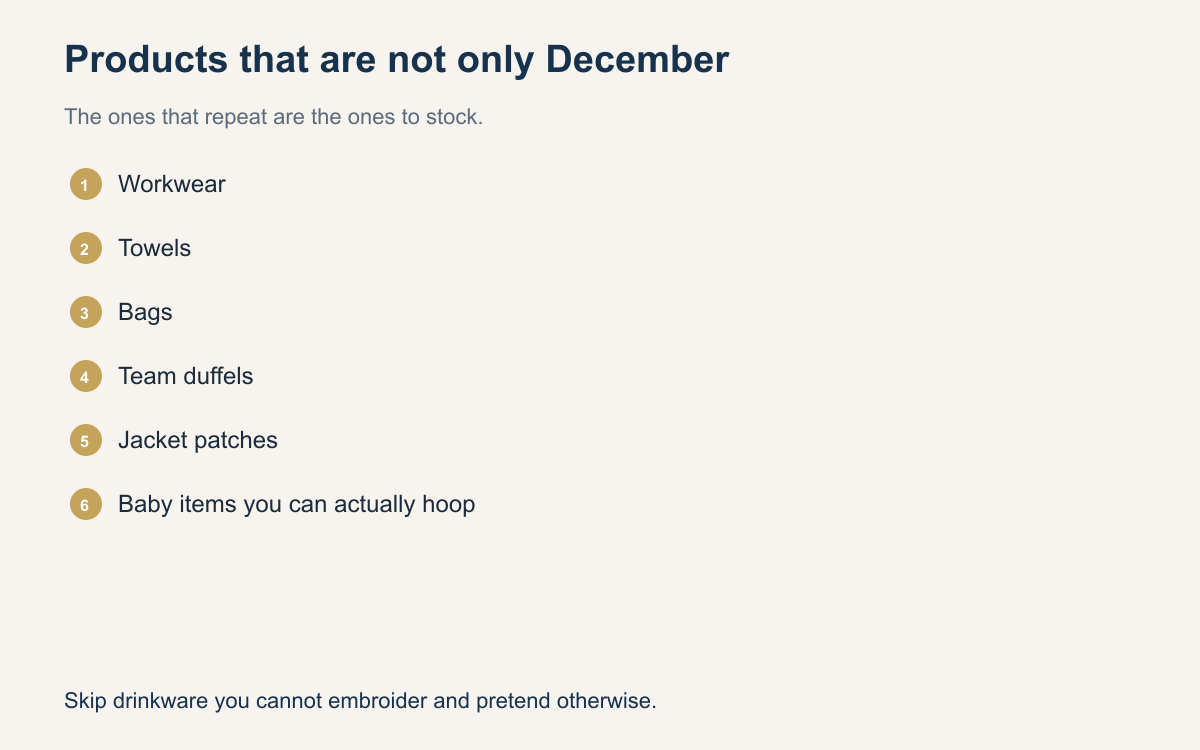
If the only products on your table are trucker hats and gifts for the holidays, you have a season, not a year. Both of those can be good work. Neither one is a calendar. A shop stays steadier when someone needs the same mark again because a shirt wore out, a new hire started, or a team opened the season. That is a different sale from a one-time present.
Underrated does not mean odd. It means the product is sitting in front of you and you keep walking past it toward the hat wall. Some of these goods repeat. Some are honest one-time jobs that still deserve a price. One of them, drinkware, is a place shops get sloppy and call a print an embroidery. Do not do that. Sort the list by what comes back.
Build the year past the holidays
December will always tempt you. People want names on blankets, logos on gifts, and a rush you can feel in the shop. Take that work if you can sew it well and if the deadline is real. Then look at January. The customers who vanish until next winter were never a base. The customers who call because a polo faded are a base.
A simple test: write down what you sewed in the last twelve months and mark which jobs had a second order. If the second order is almost always a hat for a team or a shirt for a company, you already know your year. The underrated part is everything else that could have had a second order.
Workwear is the quiet repeat
Polos, button-downs, chef coats, shop shirts, and scrubs for a clinic are not glamorous. They wear out, and new people need the same logo in the same place. That is the whole business. A restaurant that adds two cooks in the spring is an order you do not have to invent. A clinic that replaces a faded chest logo is the same shape of work. You already know how to sew a left chest.
Price workwear as a program, not as a surprise. Offer a small set of blanks you sew well, a placement you can repeat, and a note about what happens when they hire. If you only stock fashion colors, you will lose the plumber who wants navy in every size. Keep the sizes you can get again. Write down the style number when you sew the first batch so the second batch matches.
Towels and bags have a date on them
Salon towels, gym towels, and bar towels look humble and they come back when the old ones go gray. The design has to be simple. A huge fill on terry cloth is a fight you will lose, so use a mark that can sit on a stable area with the right backing and topping. Tell the buyer the truth about size. A salon that reorders every quarter is the version worth keeping.
Bags split into two kinds. A one-off tote for a market is a gift with a handle. A team bag, a camp duffel, or a staff tote with the same mark every season is a product. The second kind repeats when the season returns, not every week, so do not pretend it is weekly bread. It does fill a month that hats do not own. Hoop the panel that is actually flat.
Baby goods are often one time
Blankets, bibs, and onesies are lovely work and a hard way to fill a year unless a boutique or a hospital program reorders. Most baby jobs are a name, a date, and a grandparent who will not be back until the next baby. Charge them as custom, with a design fee that respects the setup, and do not build your rent on them. If a shop for children wants twenty of the same simple mark every month, that is a different product. Ask which one you are being offered.
The sew itself needs limits. Tiny garments pucker. Thin fabric shows every density mistake. A name in satin has a size floor, and a date in hairline type will not read. Show a sample on the same goods or say you will not guess. One careful job leads to the next cousin. One wrinkled one ends the referrals.
Patches for jackets people already own
A jacket the customer already loves is a common request and a common disaster if you hoop the jacket. Leather, lining, and a fit you did not sell are a bad combination. A patch is the underrated middle. You sew a mark you can control, they have it sewn or ironed where they want, and a mistake costs a patch instead of a coat. Clubs, shops, and little leagues already understand patches.
Say what the patch is. Twill or a similar base, edge you will actually finish, size that fits a chest or a sleeve, and a price for one versus a dozen. Offer to sew it onto a garment you trust, and refuse garments you do not. The repeat here is weaker than workwear. Individuals buy one. Teams and crews buy a handful every season. That is still useful money in a month when hats are quiet.
Do not fake embroidery on drinkware
Cups, tumblers, and bottles are not embroidery unless there is thread in a substrate that can hold thread. A wrap, a print, or a laser mark can be a fine product for someone else. It is not your needle. If a customer asks for an embroidered tumbler, say what you can do: a patch on a sleeve, a cap that matches, or a referral to a decorator who actually marks drinkware. Pretending earns a bad review for a process you do not even run.
The products that actually repeat, in the shops I trust, are workwear first, towels for a business second, and team or staff bags when the season is real. Patches repeat for groups. Baby goods mostly do not, and that is fine if you price them as one-time custom. Hats can repeat too, and they are not the only door. If you add one product this quarter, add the one a business will need when someone new is hired.
- Workwear repeats when uniforms wear out and when a new hire needs the same mark.
- Towels repeat for salons, gyms, and bars if the design stays simple enough for terry.
- Team and staff bags repeat with the season, not every week.
- Baby items are usually one-time unless a shop reorders the same mark.
- Patches repeat for clubs and crews and keep you off jackets you cannot replace.
- Drinkware is not embroidery. Sell thread on fabric, or say who does the cup.
You need a blank a business will ask for again, a design you can repeat, and the honesty to leave drinkware to a process that is not a needle. Hats can stay. They should not be the only offer.
A question for the group
Which product outside of hats has actually reordered for you, and which one did you expect to repeat but never did?