
Pricing
The 15 dollar hat that costs you 25
A decorated hat sold for 15 dollars can hide a blank in the 8 to 12 dollar wholesale band, thread, backing, a failed sew-out, a short digitize, a mailer, and the minutes you spent answering the message. The stack below is an illustration that lands near 25 dollars before profit.
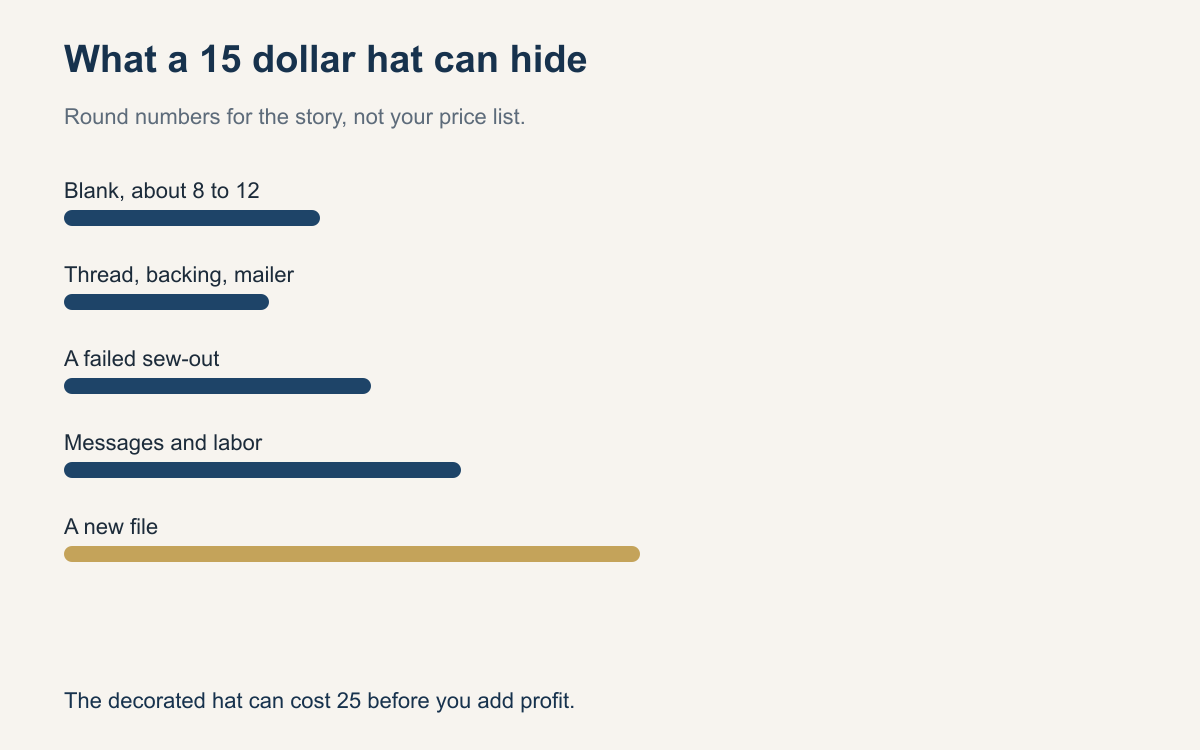
A 15 dollar hat is an easy number to paint on a sign and a hard number to survive. The blank alone often wholesales in a band of 8 to 12 dollars before a single stitch. Thread, backing, a sew-out you cannot sell, a few minutes of digitizing, a mailer, and the time you spent answering the message sit on top of that blank. Add them with round figures and a careful one-off can land near 25 dollars of cost before you have kept a dollar of profit.
Treat every number below as an illustration, not a price list for the industry. Your catalog, your miss rate, and your inbox will not match this picture. The habit is the point: write the hidden lines down before you answer "15 dollars" in a message. If your real stack is 22 or 31, quote from that stack. Do not quote from the sign you saw on a highway.
The blank is the first hidden cost

Shops remember an old blank price and keep selling against it. A common structured cap in this illustration wholesales at 10 dollars, inside the 8 to 12 dollar band. A heavier cotton or a brand the customer named can sit at the top of that band. A sale blank you already own from a canceled order can sit under it. Use the invoice in your hand, not the memory. If you paid 11, the hat starts at 11 even when the decoration feels small.
The 15 dollar sale price now has 5 dollars left in this illustration, and you have not sewn, not bagged, and not written back. That leftover has to cover thread, backing, mistakes, the file, the mailer, and your time. It will not. The blank did not get cheaper because the customer called the job a name on a hat. Put the wholesale number on the ticket as its own line so it cannot disappear into "the hat was cheap."
Thread, backing, and the hat you scrap
Thread and backing feel like pennies until you add topping, a needle, and the stabilizer you throw away. This illustration rounds thread to 1 dollar and backing plus topping to 1 dollar, so the line is 2 dollars and visible. Your cone cost may be lower on a one-color name and higher on a dense mark. Round up until you have weighed a real job. Calling the line zero is how the stack lies to you.
The failed sew-out is the hat you do not get to sell. A popped hoop or a design on the seam still belongs to you. If you wreck one blank in five, a 10 dollar blank puts about 2 dollars of waste on every hat you sell. On a true one-off you might eat the whole first blank. This illustration uses 4 dollars as a middle picture. If the first hat is scrap, add the full wholesale instead, and the stack jumps well past 25.
An illustration that lands near 25

Here is the careful stack, labeled as an illustration with round numbers. Blank 10 dollars. Thread and backing 2 dollars. A share of a failed sew-out 4 dollars. A short digitize for a simple name, about ten minutes, 4 dollars. A mailer or a finished bag 1 dollar. The time to answer the message, about fifteen minutes at a modest 16 dollars an hour, 4 dollars. The total is 25 dollars. You have not added profit. You have not added a rush. You have described a hat that was not a hard logo.
Read the digitize line twice. Four dollars is a short text you can program quickly, not a crest. If the customer sent a real logo that takes an hour, add that hour on top of the 25. The 15 dollar price is then not in the same conversation. Message time moves the same way. At 40 dollars an hour, those fifteen minutes are 10 dollars, not 4, and the careful stack becomes 31 before profit. Use the rate you need. The 25 dollar picture is the low, tidy version of a one-off, and it already beats a 15 dollar sale by 10 dollars.
- Blank, inside an 8 to 12 dollar wholesale band: 10 dollars in this illustration.
- Thread: 1 dollar.
- Backing and topping: 1 dollar.
- Share of a failed sew-out: 4 dollars, or the full blank if the first hat is scrap.
- Short digitize for a simple name: 4 dollars. A real logo is extra.
- Mailer or finished bag: 1 dollar.
- About fifteen minutes answering the message: 4 dollars at a modest rate.
- Illustrated cost before profit: 25 dollars.
- Sale price on the sign: 15 dollars.
- Gap on this picture: 10 dollars, and profit is still not in the stack.
Where the 15 dollar price comes from
The 15 dollar number usually comes from a competitor or a customer who thinks decoration should be "about 10." None of them paid your wholesale invoice. If you want a low price, build it only from a blank already paid inside a larger order and a file you already keep. Even then, run the stack. Delete the miss line and the hat in the trash will put it back.
What to charge instead
Start from your stack and add the profit you actually want. A 25 dollar cost with a 25 dollar price is break-even, which means you bought yourself a chore. Many small shops need a simple supplied hat, file already saved, to land in the mid 30s before it feels like a wage. A new logo moves higher because digitizing is its own line. "A one-off name on a cap I supply is 36 dollars" is a complete answer in this illustration. Change the 36 to your stack.
You can still say yes to a 15 dollar hat in one narrow case: the blank was already paid by another job, the file already exists, you are not opening a new message thread to redesign it, and you are sewing it between paid pieces. Count that as filling a gap, not as the shop price. The moment any of those conditions fails, the stack returns, and the sign is wrong again. Put the real one-off price on the card by the register so a busy afternoon does not invent 15 dollars from memory.
Before you answer the next "how much for one hat" message, write six lines: blank, thread and backing, a miss you might eat, digitize if the file is new, mailer, and the minutes the message already took. Add them. If the total is near 25 dollars or past it, do not sell the hat for 15 unless you are choosing to lose that money on purpose. Replace this illustration with your invoices. The sign can wait until the stack fits under it.
A question for the group
When you last sold a single decorated hat, what did the blank, the mistakes, and the messages cost you before you named a price?