
The industry
Single-needle or multi-needle: when to upgrade
A multi-needle machine saves the stops between colors. It does not save a shop waiting on art, and it does not make a quiet week look legitimate. Upgrade when color changes eat hours you can count. Stay put when the reason is boredom or pride.
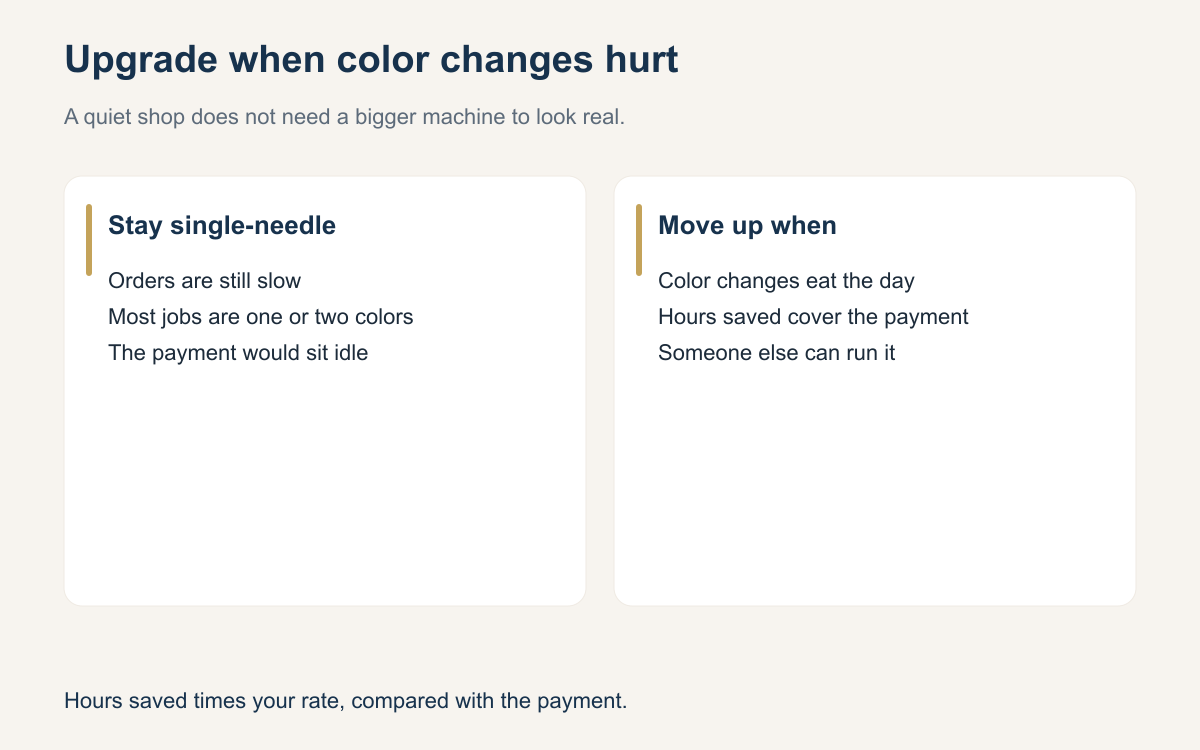
Needles are a capacity tool, not a personality. A single needle can sew beautiful work all day if the designs are simple and you are not standing there rethreading. A multi-needle head earns a payment when the same job would have stopped you over and over for color. If you are shopping because the single needle feels small, pause. Empty needles do not fill the calendar.
The decision is clearer on paper than it is at a booth. Write the hours you lose to color changes in a normal week. Multiply by the rate you want for that hour. Compare the result to the payment on the bigger machine. The illustration below uses sample numbers. Replace them with yours. If the hours are not there, the machine is a feeling with a bill.
What a single needle still does well
A single needle is the right machine when most of your work is one to three colors and you are not behind. Left-chest names, a small cap wordmark, a one-color team mark: you thread, you sew, you move on. The machine is paid for, you know the noises, and a new hire can learn one head. There is no prize for owning iron you do not need.
Mistakes stay cheaper too. A bad file on one head ruins one sew-out, not a row of them. If your volume is a few jobs a day and color changes are rare, spend the next dollar on backing, a better hoop, or time to fix quotes. Those return more than a head that sits threaded in colors you use twice a month.
Color changes are the real reason
Every color on a single needle is a stop. You trim, you rethread, you check tension, and you start again. Six colors on forty hats is a long chain of those stops. Even if you batch by color, you still walk over or you rehoop. That walk is labor, and labor is the bill a second set of needles is supposed to shrink.
A busy single-needle shop should upgrade when those stops are why orders slip, not when the owner is bored of the machine. If you are slammed and every job is one color, a trimmer you trust may matter more than six heads. If the late jobs were the colorful ones, you have an answer. If they were waiting on art or on a reply that never came, needles will not fix the week.
Count labor, not just needles
The person at the machine is the cost people forget to write down. If that person is you, the hour has a rate you wish you earned. If you pay someone, the hour has a wage plus the time you spend checking the work. A multi-needle machine that lets one person sew a six-color logo without six stops gives that hour back. A machine that still needs you for every hoop does not, no matter how many needles it has.
Capacity is not the same as a full day. Extra heads do not double the week if you are waiting on files, blanks, or a yes. Buy needles for minutes you can name. If you cannot point to a stack of multi-color jobs from last month, you are buying room for work you do not have. Room feels like growth. It is still a payment.
A return illustration on one sheet
Do this on one sheet, and call every number an illustration until you swap in your own. Suppose color changes eat four hours in a normal week, and you value that hour at forty dollars. Four times forty is one hundred sixty dollars a week. Call the month roughly six hundred forty dollars. That is an illustration, not a wage survey and not a dealer quote. Then write the weekly payment on the bigger machine.
If the payment sits well above the hours you get back, and you have no other gain you can name, you are buying a feeling. If the hours cover the payment and you already have the colorful work, the upgrade is a tool. Rerun the sheet on an ordinary week, not your best week. A machine that only pays for itself in December will nag you in March.
A quiet shop should not buy status
A quiet shop does not become legitimate by owning a bigger machine. Customers cannot see the needle count from the parking lot. They see whether you answer, whether the sew-out is clean, and whether the cap was ready when you said. A paid-for single needle and real jobs beat a financed row of heads. Fill the week you have before you add needles.
Sometimes the single needle really is the ceiling. You turn work away every week because color changes blow the schedule, and the customers are real. That is an upgrade. Boredom is not. Pride at a trade show is not. A friend who says single-needle shops look amateur is not. You can be excellent on one needle, and you can outgrow it. The sheet of paper knows which one you are.
How to decide from last month
Pull the last twenty jobs. Mark how many colors each one had and whether you were late. If the late ones are mostly one color, the problem is hooping, art, or promises, and more needles are a detour. If the late ones are four colors and up, price the payment against the hours in the illustration and see if an ordinary week covers it.
Then ask the person who sews, even if that person is you on a calmer day, which stop they would pay to delete. If the answer is rethreading, you are looking at the right machine. If the answer is hunting for a file or waiting on a text, stay on the single needle and fix that stop first. A new head will not answer the text.
- Count color-change stops on a real week, not on a demo design.
- Multiply hours you would get back by the hourly rate you want, and call the rate an illustration until it is yours.
- Compare that weekly number to the weekly payment, not to a sticker you half remember.
- Upgrade when colorful jobs are what make you late and the payment fits those hours.
- Do not upgrade because the single needle feels small or because the week is quiet.
- If art, proofs, or missing files are the delay, fix those before you add needles.
A multi-needle machine is worth it when color changes eat hours you can sell again. It is a poor purchase when you want to feel finished as a shop. Run the illustration with your week and your rate. If the payment fits and the work is already in the door, buy the tool. If the week is quiet, keep the single needle and go find the work.
A question for the group
Are you late because of color changes, or because the work is not there yet, and which of those were you about to solve with a bigger machine?