
Pricing
Should you charge a digitizing fee?
Charge a digitizing fee as its own line on a new file, fold it into the piece price only when the run is large enough to see, and waive it on a reorder of the same saved file. An edit is not a reorder. The amounts below are an illustration.
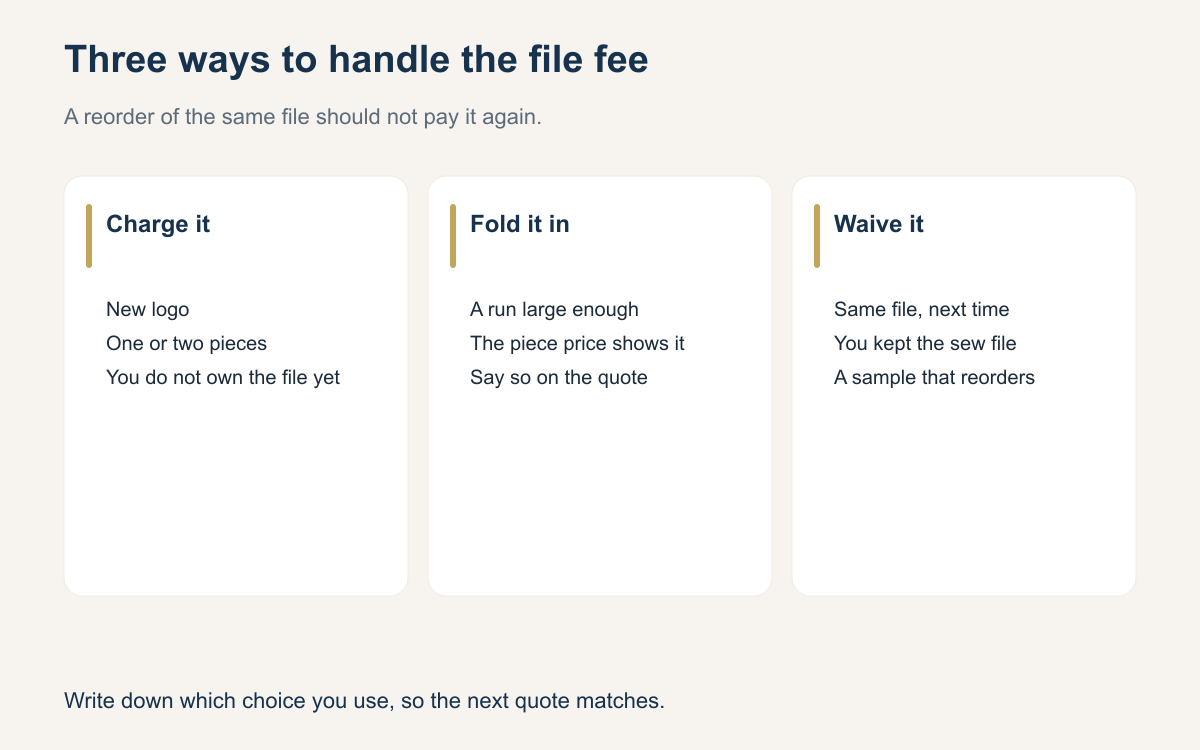
A digitizing fee is not a punishment for wanting a logo. It is the bill for a file that did not exist this morning. You have three honest choices: charge it as its own line, fold it into the piece price when the quantity can carry it, or waive it when the customer reorders the same file you kept. Mixing those choices at random is how the second order argues with the first.
The fees below are an illustration. A simple logo might be 45 dollars of your time or of an outside bill. A small-detail crest might be 90. Your number comes from the hour you actually spend, or from the invoice you actually pay. If you charge less than that bill, you are donating the difference. Replace the figures. Keep the rules.
When the fee is its own line
Use a separate line when the file is new and the run is small. One hat to a dozen pieces is the usual case. If you hide 50 dollars inside the piece price, one hat looks absurd and twelve hats look expensive for a reason the customer cannot see. A line that says digitizing 50 dollars, sewing so much a hat, blanks separate, is a conversation you can finish. The customer can also decide to bring a simpler mark, or to wait until they have a dozen, which is a better order for both of you.
The separate line also makes the reorder obvious. You point at it and say it does not appear next time if the art stays the same. In this illustration a simple new logo is 45 dollars and a crest with tiny detail is 90, because the crest takes longer than an hour and may need a sew-out you throw away. Do not publish those as law. Time your last three files. If the outside digitizer charged you 35, your fee has to cover 35 or you lost money before the machine started.
When to fold it into the piece price
Fold the fee into the piece price when the run is large enough that the slice is small and the customer wants one number. Sixty dollars across 60 hats is 1 dollar a hat. You may quote 19 a hat all in for sewing and the file, blanks aside, if your other costs support 19. This illustration only shows the digitizing slice. The rest of the price still has to pay labor, materials, overhead, and profit. Folding is a way to speak the total. It is not permission to forget the fee on your copy of the ticket.
On the internal ticket, write the digitize as 60 even when the customer saw one number. Next season the reorder is priced without that 60. If you only stored the blended 19, you will either charge the digitize again by accident or keep charging a dollar that no longer buys anything. Shops that sell packages can do the same thing with two package prices: a new-logo package, and a same-file reorder. Both can be a single number at the counter. Both need the split written down where you can find it.
When you waive it
Waive the digitizing fee when the reorder is the same file. Same art, same placement family, no new words. You kept the file, so they should not rent it twice. Say that at the first sale so it feels like a rule and not a favor you might forget. Repeat orders are where a small shop actually makes a calm profit, because the scary hour is already done. Charging the fee again teaches the customer to shop the logo around, and it charges them for work you are not doing.
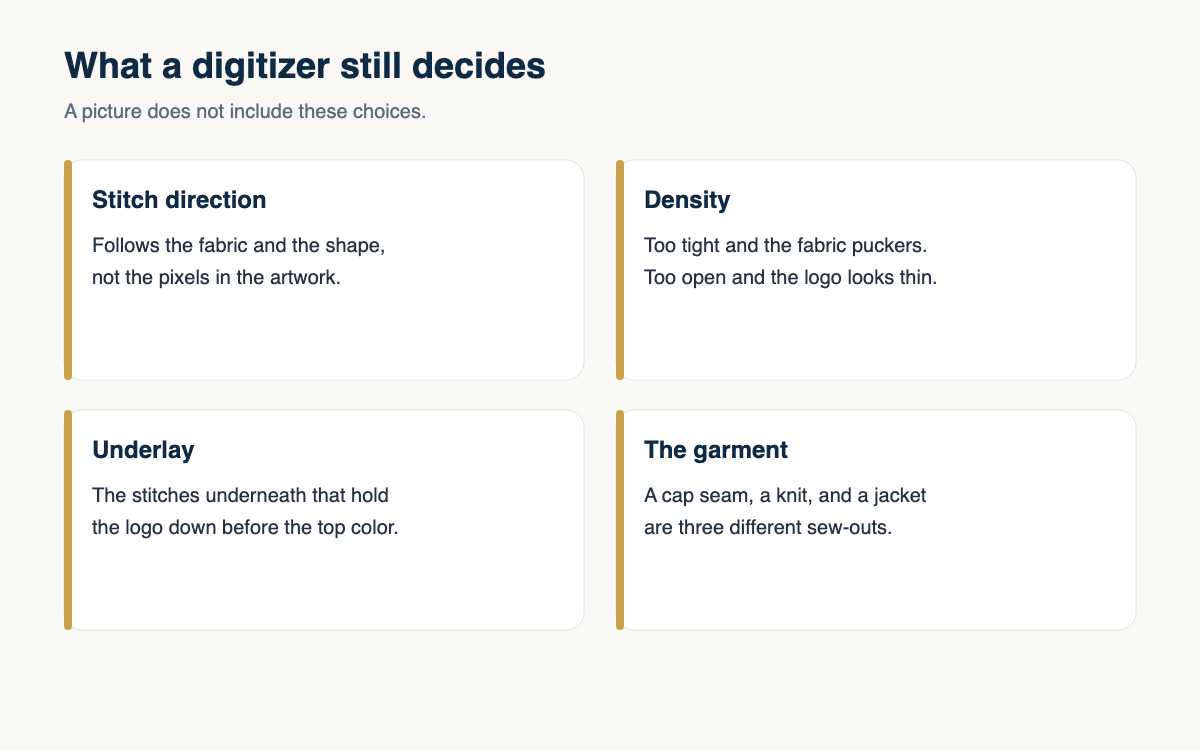
An edit is not a waiver and not a full new fee unless the art truly starts over. In this illustration, a color swap you can do in a few minutes is 15 dollars. A new word, a new icon, or a fabric that needs a different underlay is new work: charge the edit or a new digitize, and say which one before you open the file. If the customer calls it "basically the same," read the art. Basically is how a 15 minute favor becomes a second crest. You can be warm and still name the line.
- New logo, small run: digitizing is its own line on the quote.
- Illustration, not a law: about 45 dollars for a simple logo, about 90 for a detailed crest.
- Large run: you may fold the fee into one piece price if the internal ticket still shows the fee.
- Same saved file, no art change: waive the digitize. Do not charge it twice.
- A small color edit: an edit fee, illustration 15 dollars, not a new crest fee.
- New words, a new icon, or a new fabric that needs a new underlay: new work, new line.
- If an outside digitizer billed you 35, the fee you charge has to cover that 35.
Keep the file or you cannot waive anything
The waiver depends on you actually having the file. Name it with the customer and the design, and store it next to the approved art. If you cannot find it next year, you digitize twice and the second bill is yours. Tell them: "I keep your file. The next order of this same design has no digitizing fee." Decide in advance whether a paid file can leave the shop. An unstated rule becomes a fight.
What to say at the counter
Use one short policy. "A new design has a digitizing fee. A later order of that same design does not. If the art changes, there is an edit fee." Then give the number. In the illustration, "this logo is 45 dollars to digitize, and sewing is separate." The fee is for the file, it happens once, and a change is a different purchase.
If they ask you to waive it on the first order, the answer is about the hour. "The fee covers making the file. I do not charge it again when you reorder this design." Fold it into a larger run only when the math works. A waived first fee with a plan to collect it later is a plan to argue later.
Mark the next file as new, folded, or a reorder before you send the quote. New gets a line the customer can see. A true reorder of a file you can find gets a zero. An art change gets an edit price you say before you touch it. Replace the 45, the 90, and the 15 with your real file costs.
A question for the group
Do you charge a digitizing fee as its own line, fold it into the piece price, or waive it, and what do you do on the second order of the same file?