
Growing the shop
Should a small embroidery shop offer free shipping?
Free shipping is a price decision. It works only when the garment price or a minimum order covers the mailer and the postage. A flat ship fee is clearer when orders are not the same size or the same distance.
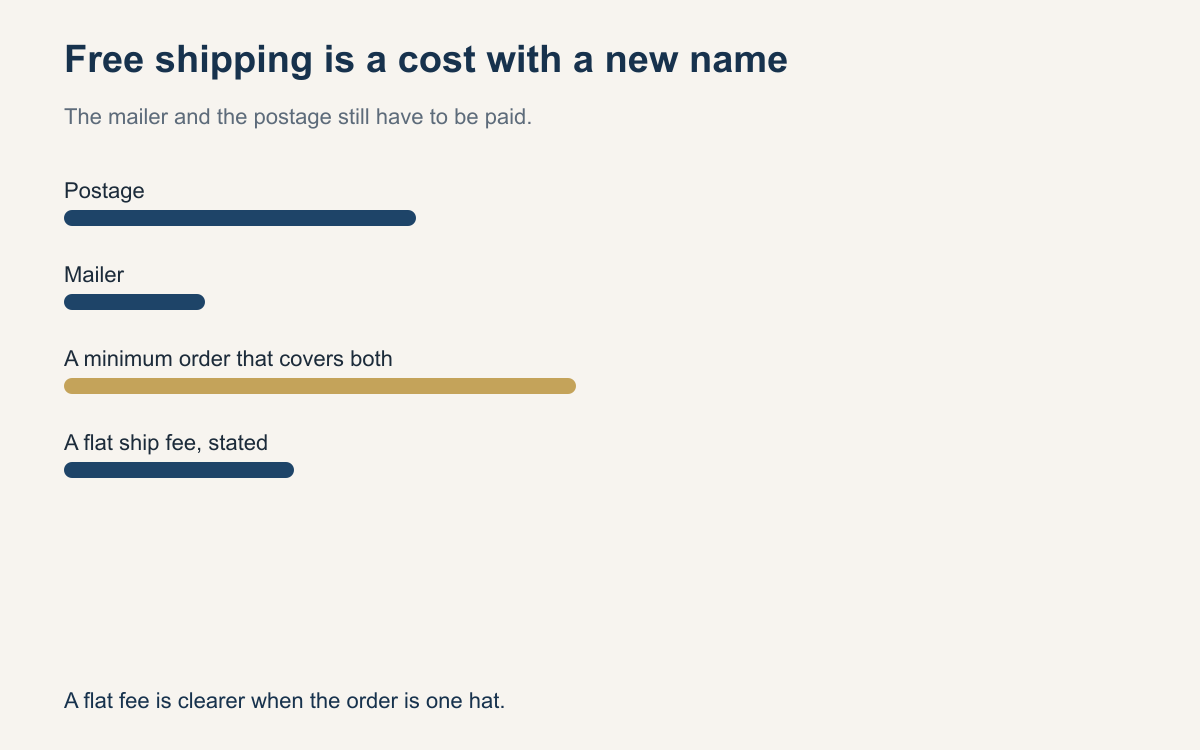
Buyers like the words free shipping, and the post office does not. A mailer and a stamp are costs, the same as thread. If you call shipping free and leave the garment price alone, you pay those costs out of the decoration. Sometimes that is a smart offer. Often it is a slogan copied from a warehouse that ships thousands of identical boxes.
A small embroidery shop should offer free shipping only when the math is boring and covered. Use a round illustration and stick to it. Then decide whether the covered version, a minimum order, or a flat fee is the sentence you can say out loud without wincing when the box is heavy.
Shipping is a cost even when the label says free
Picture one decorated cap with a selling price of 30 dollars. The mailer costs 2 dollars. Postage to most of the country costs 8 dollars. Together the mailer and the postage are 10 dollars before you count the minutes to fold, label, and stand in line. That 10 dollars does not disappear because the product page says shipping is free.
If the cap stays at 30 dollars and shipping is free, you collect 30 and spend 10 to mail it. The decoration has to absorb that 10. On a job with healthy margin you might choose that on purpose, as a simple offer for a single local-looking order. On a job you already priced tight, the 10 dollars is the profit. Call it a choice. Do not call it free in your own books.
Build the mailer and the postage into a number
The covered version of the same illustration is a cap at 40 dollars with shipping included. The buyer still pays the 10 dollars. They pay it inside the price instead of on a second line. This is honest when almost every order is one cap, in a similar mailer, going a similar distance. Your ads can say shipping is included, and your margin does not depend on hope.
Do the arithmetic on the package you actually send. One cap in a small mailer is the 2 plus 8 illustration, 10 dollars. Two caps in one box are not automatically 20 dollars. The mailer may still be a couple of dollars, and the postage may be 12 instead of 16. Use the real stamp for that box, then decide how much of it sits inside the garment price. Round numbers are for explaining the offer. The scale at the counter is for setting it.
A minimum only works if the box math works
Free shipping over 60 dollars, in this illustration, is two caps at 30. That offer works only if the box you really send costs less than the amount you built in. If two caps ship for 12 dollars all in, then a 60 dollar order covers the 12 only when those 12 dollars live somewhere: in the cap price, in the rule, or in a margin you are willing to spend. If you priced the caps as if they were picked up at the door, the minimum does not save you.
Write the minimum next to what it assumes. Free shipping over 60 dollars inside the lower forty eight, one address, no rush. A rush stamp, a second address, or a case of jackets is a different box. Say so. A minimum that pretends every package costs the same will be loved by the buyer with the heavy order and resented by you on Friday when the label prints.
Charge a flat fee when orders are not alike
Keep the cap at 30 dollars and charge a flat 10 dollars to ship, and the buyer sees the sewing price and the mail price as two numbers. That is clearer when orders vary. A single cap and a carton of jackets should not pretend to cost the same to mail. A flat fee is also clearer when some people pick up. The local buyer should not pay a hidden 10 dollars inside a hat they will carry to the car.
Use a flat fee when weights jump around, when you ship both across town and across the country, or when one heavy coat would make a free offer foolish. You can still round it. A flat 10 dollars on the cap illustration matches the mailer plus the postage, and you can publish a second flat fee for a larger box if you know that box. Two honest numbers beat one cheerful word that is only true for the smallest order.
Pick the offer you can explain in one breath
You have three clean versions of the same 30, 2, and 8 illustration. Leave the cap at 30 and eat the 10, which is only sane when the margin is there. Raise the cap to 40 and include the 10, which fits a shop that ships one similar parcel all day. Charge a flat 10 and keep the cap at 30, which fits mixed orders and pickup. A minimum at 60 is a fourth version, and it only works after you price the real box.
Say the offer in one breath and put it next to the price. Shipping is 10 dollars, or shipping is included in the 40 dollar cap, or shipping is free over 60 dollars on one address. If you need a footnote for half the orders, the offer is too cute. Buyers can accept a fee they understand. They feel tricked by a free label that becomes a surprise at the last step, or by a price that jumped with no sentence explaining the mail.
- Add the mailer and the postage before you say shipping is free.
- On a 30 dollar cap, a 2 dollar mailer and 8 dollar postage are 10 dollars.
- A 40 dollar cap can include that 10 when every box is similar.
- A flat 10 dollar ship fee keeps pickup and heavy boxes honest.
- A 60 dollar minimum covers two caps only if the real box costs what you planned.
- Publish one sentence a buyer can repeat without calling you.
Choose the version that matches the boxes you actually tape. If most of your work is one cap mailed a similar distance, include the 10 dollars in the price and say shipping is included. If the work is mixed, charge the flat fee and let pickup stay pickup. Free shipping is a good offer only after the mailer and the postage are paid by the price or by the minimum. Until then it is a discount you did not mean to give.
A question for the group
On your last ten shipments, what did the mailer and the postage actually cost, and does your current free shipping offer cover that number?