
Thread
Rayon, polyester, cotton, and metallic embroidery thread
These threads are not interchangeable cones of color. Sheen, strength, and how hard they are to sew should decide which one is on the machine.
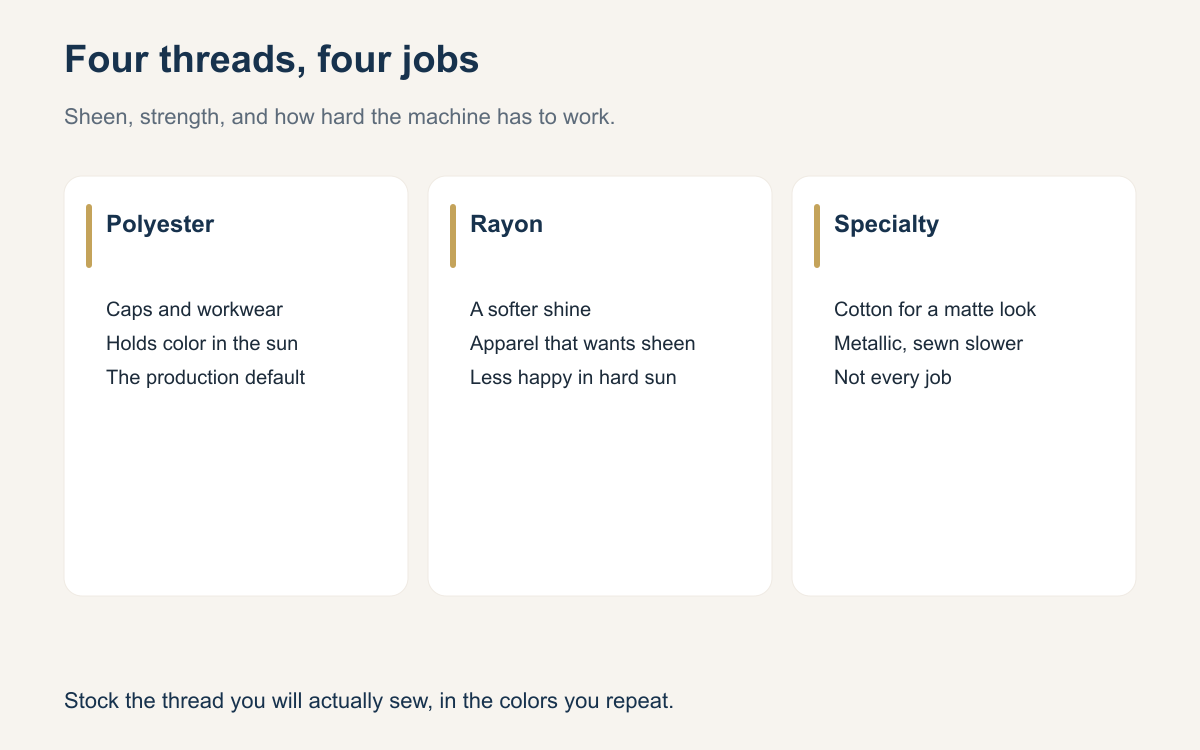
Shops inherit a wall of thread and then buy whatever matches a logo. The material is an afterthought until a cap fades, a metallic job shreds, or a cotton cone lint-bombs a machine that was running fine on polyester. Rayon, polyester, cotton, and metallic are different tools. You can stock more than one. You should not pretend they sew the same.
You also do not need every brand. Pick one polyester line and, if you sew apparel that wants shine, one rayon line, and learn their color charts. Add cotton or metallic when a job truly calls for them, with the slower setup those cones demand. A wall of random cones is not a thread program. It is a matching problem waiting for a reorder.
Polyester is the production default for a reason
Polyester embroidery thread, the kind shops know from lines like Isacord or Madeira Polyneon, is strong and holds its color in sun and washing better than rayon. That is why it became the default on caps, bags, and workwear. It has a sheen, but it is usually a quieter sheen than rayon. If you sew a logo once and the hat lives on a dashboard, polyester is the responsible choice. The customer will not thank you for a rayon red that goes pink.
It still breaks if the needle is wrong, the path is rough, or the density is ridiculous. Polyester is tough, not magic. When a shop says “polyester never breaks,” they mean it survives their normal settings. Do not switch a problem file to polyester and call that digitizing. Do stock it in the colors you repeat, because a special-order cone for every small job is how the wall fills up with orphans. A tight palette of polyester will sew most commercial logos.
Rayon is the shine, with a limit
Rayon is the older dress thread of embroidery. Brands such as Madeira rayon, Robison-Anton rayon, and Sulky rayon are loved because the sew-out has a softer, brighter sheen. On a jacket back or a retail apparel logo, that shine can look more expensive than polyester. It is also less resistant to UV and, in a lot of shops’ experience, a little less forgiving when the machine is angry. Use it when the look is the point and the garment will not live in a shop window.
Do not mix rayon and polyester in one design and expect the sheens to agree. They can be close in a chart and look like two different reds on the shirt. If a reorder was sewn in rayon, sew the reorder in rayon, or tell the customer you are changing the material and show a scrap. “Same color number” across two materials is not the same sew-out. Note the material on the file, not only the color number. The number without the material is how the second order looks wrong.
Cotton and metallic are specialty setups
Cotton embroidery thread looks matte. That is the reason to use it: a vintage mark, a quilted piece, a design that should not shine. It tends to lint, it is weaker than polyester, and it is a poor default for a cap shop that wants speed. If you offer it, sew slower, expect to clean the machine, and price the extra handling. Do not let a customer assume cotton is “more premium” in the sense of stronger. It is more specific. Strength is the polyester’s job.
Metallic thread is a look people request for holidays, sports, and logos that want a glint. It is also the thread most likely to break, fray, and ruin a schedule if you sew it like polyester. Use a needle with a larger eye, slow the machine, consider topping so the stitches sit up, and keep the design from being a dense fill of long stitches. Metallic as a small accent is a different job from a metallic field. Quote it as its own setup. If you have never sewn that cone, sew a scrap before you promise Friday.
Stock what you repeat
A practical wall is a polyester line in the colors your customers actually reorder, plus black, white, and a few navies and reds you could match in your sleep. Rayon joins that wall if your work is apparel that sells the shine. Everything else can be ordered for the job. Write the brand and the color number on the order and on the spool if you rewind. Future you should not have to hold cones up to a hat in bad light.
When you change brands, do not assume the numbers match. Isacord 0101 is not a universal white across every catalog. Keep the old cone until the current orders are done, or sew a comparison. Thread is cheap next to a rejected set of polos. The expensive move is switching materials mid-program because a website said another brand was better. Switch when you have a reason on your own machine, and then stay there long enough to learn the chart.
- Use polyester for caps, workwear, and anything that sits in the sun.
- Use rayon when you want the higher sheen and the garment can live with it.
- Keep cotton for matte, slower jobs, not as the default cone.
- Sew metallic slower, with a larger-eye needle, and quote it as a setup.
- Write the brand and the color number on the order.
- Do not mix materials in one logo and expect the shine to match.
The right thread is the one whose look you want and whose behavior you already know on your machine. Polyester will carry most shops. Rayon is a shine you choose. Cotton and metallic are specialties with a slower setup and a price that should show it. A random cone that “looks close” is how reorders drift.
Check the cone on the machine right now. If you cannot name the material, you do not know what you are promising the next time that color comes back.
A question for the group
What is your default thread, and which job finally made you keep a second material in the shop instead of forcing everything onto one cone?