
Pricing
What to charge for a 10,000-stitch design
A 10,000 stitch design is machine time plus hoop, trim, backing, and bagging. Digitizing is a separate line when the file is new. Two shops with different hourly rates will not land on the same price, and the figures below are an illustration to replace.
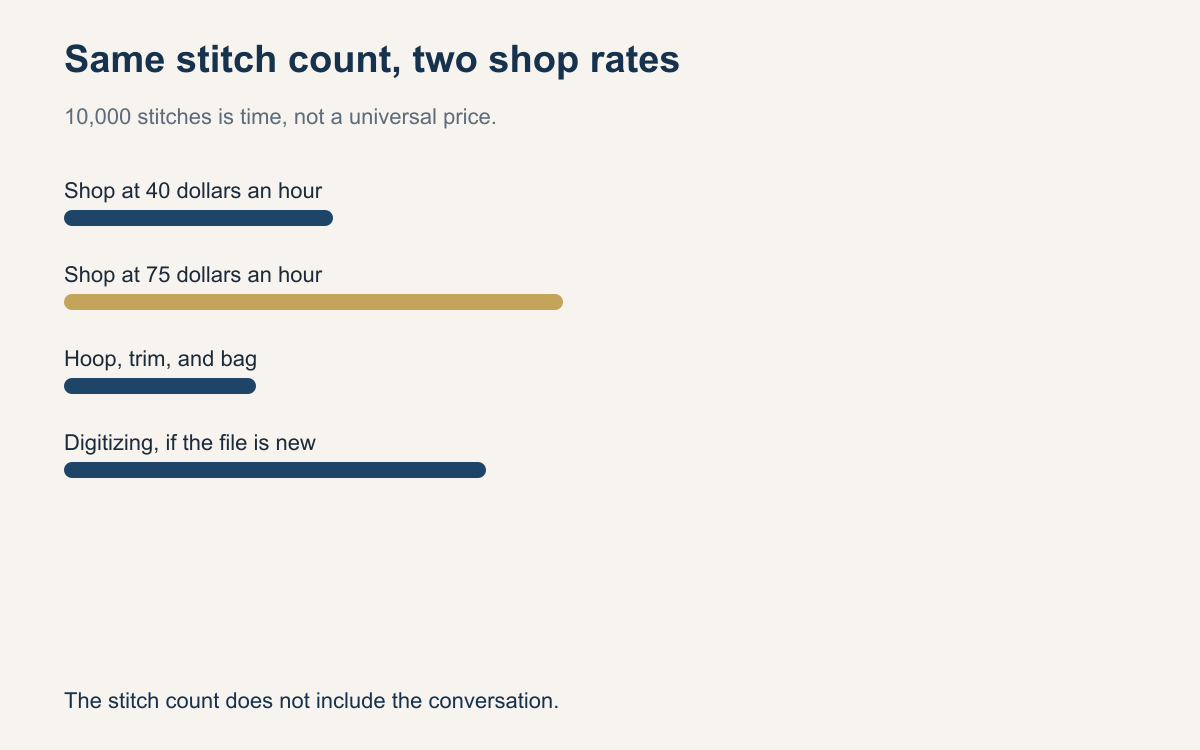
A 10,000 stitch design is not a price you can copy off a chart. It is a block of minutes at your machine, plus the hoop, the trim, the backing, and the bag. Digitizing is a separate line when the file is new, and it is zero when you already keep that file. Two honest shops can sew the same file and quote two different numbers because the hourly rate is a decision about wages and rent, not a law of thread.
Every dollar figure in this walk-through is an illustration with round numbers. Replace the rate, the minutes, and the digitizing fee with what your shop actually spends. The shape of the cost is the lesson. The exact dollars are yours to measure on your own floor, on your own blanks, with your own needle speed.
What 10,000 stitches take in time
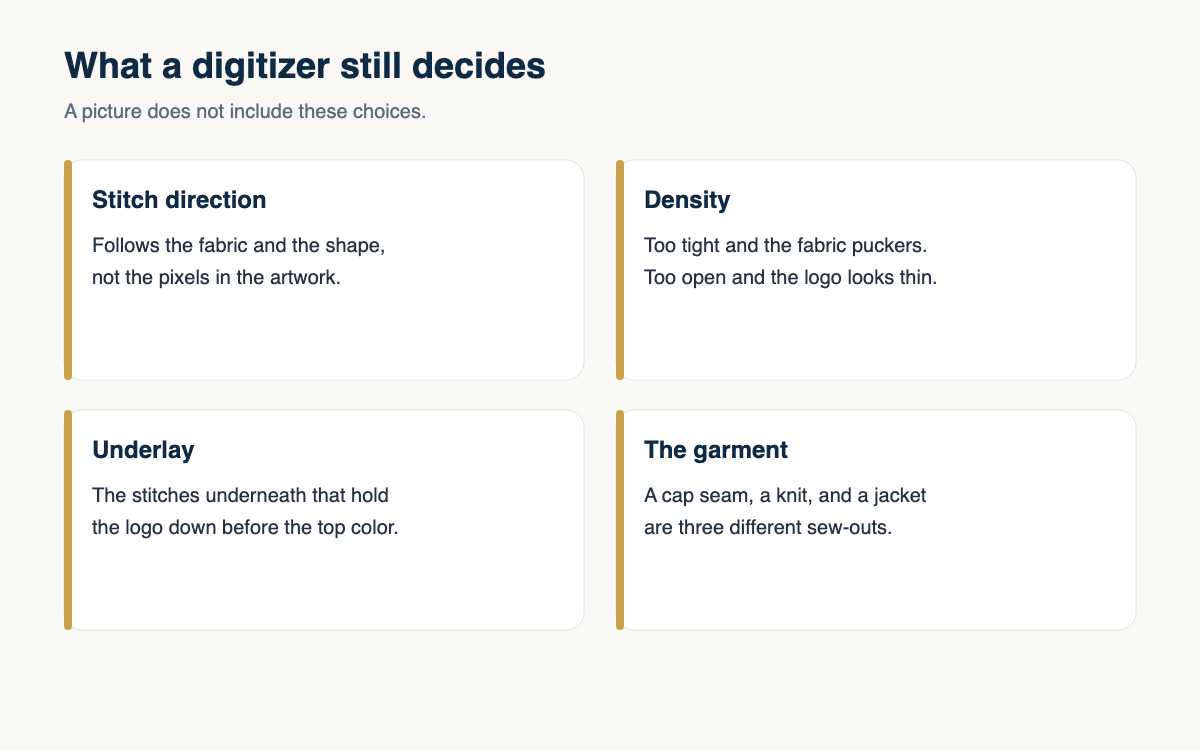
Use a planning speed only as an illustration, not as a promise. At 700 stitches a minute, 10,000 stitches are about 14 minutes of needle-down time. Color changes, jump trims, a thread break, and the moment you stop to look at the edge push that to about 20 minutes of real attention at the machine. A one-color fill and an eight-color crest can share a stitch count and still not share a clock.
The garment changes the clock again. A flat left chest in a mighty hoop may hit that 20 minute picture. A structured cap can add hoop struggle the stitch count never mentions. If your machine is happier at 600 stitches a minute on logos, plan with 600. If a calm operator on a simple design holds 800, plan with 800. Write the number you have timed, then price the minutes you timed.
Hoop, trim, backing, and the bag
The needle time is the middle of the job. Before it, somebody hoops and aligns. After it, somebody trims jumps, clips the back, and bags the piece. In this illustration those steps are 12 minutes: about 6 to hoop and align, 4 to trim, and 2 to bag. Add the 20 minutes at the machine and you are at 32 minutes of labor for one 10,000 stitch sew-out. Your minutes will differ. Time three real pieces and replace this picture.
Materials in the same illustration are small and easy to forget. Backing, a scrap of topping on a knit, and a poly bag come to about 1 dollar. Thread for a normal logo is inside that dollar if you want one round line, or split it out the day you weigh a cone. None of this is a universal law. A cap with cutaway and a spray adhesive habit can cost more. A stable woven with tearaway can cost less. The point is to put a number on the line instead of calling it pennies.
Two shops, one stitch count
Shop A in this illustration needs 60 dollars an hour. That is 1 dollar a minute. Thirty-two minutes of labor is 32 dollars, plus 1 dollar of backing and bag, so the decoration cost before profit and before the blank is about 33 dollars. Shop B needs 35 dollars an hour. The same 32 minutes are about 19 dollars of labor, plus the same 1 dollar of materials, so the decoration cost is about 20 dollars. The file did not change. The life of the shop did.
Digitizing makes the gap wider when the file is new. Shop A might put 60 dollars on that line because the logo takes about an hour at the shop rate. Shop B might pay an outside digitizer 40 dollars, or spend 45 minutes and call it about 26 dollars of in-house time. A repeat of the saved file is 0 dollars of digitizing at both shops. Quote the new file and the repeat as different jobs. A customer who hears one blended number will ask you to blend it again next time, and the second order will not have the file work in it.
- Stitch count in this illustration: 10,000.
- Planning speed: 700 stitches a minute, about 14 minutes of needle time.
- Attention at the machine once stops are included: 20 minutes.
- Hoop, align, trim, and bag: 12 minutes.
- Total labor minutes: 32.
- Shop A at 60 dollars an hour: about 32 dollars of labor.
- Shop B at 35 dollars an hour: about 19 dollars of labor.
- Backing, topping, and a bag: 1 dollar in this illustration.
- New digitizing, quoted as its own line: about 40 to 60 dollars.
- A later order of the same saved file: 0 dollars of digitizing.
Why the chart from another shop fails
A price per thousand stitches feels fair until you notice what it hides. Ten cents a stitch would turn this design into 1,000 dollars, which is nonsense for a left chest. A penny a stitch would turn it into 100 dollars, which might cover one shop and bury the other. The rate per thousand only works after you already know your minutes. It is a shorthand you earn, not a number you borrow. If your hourly rate is only a wage, add a margin for rent and needles or a busy week still ends short.
How to say the price
Keep three lines even if you tell the customer one total. The blank, if you supply it. The sew: labor minutes times your rate, plus backing and the bag. Digitizing, and only when the file is new. In the Shop A illustration, a supplied shirt with a new file might be sewing 40 dollars and digitizing 60, the extra over the 33 dollar cost standing in for a little margin. A saved file drops the 60. You can say one total at the counter. Do not delete the lines from the ticket.
If a buyer says another shop will sew it for less, compare rates before you cut. Ask yourself which shop you are. If you are Shop A, matching Shop B means working for 35 dollars an hour while your costs still expect 60. That is a sale you can decline. Offer a simpler design, fewer colors, or a quantity that spreads the digitizing. Do not offer a pretend stitch price that ignores the hoop.
Time the next 10,000 stitch sew-out with a clock, including the hoop and the trim, and write the minutes on the ticket. Multiply by the hourly rate your shop actually needs, add backing and the bag, and put digitizing on its own line if the file is new. Then replace every illustration number on this page with the number you just wrote down. That is the price for your shop. The other shop can keep the other price.
A question for the group
What hourly rate are you actually using when you price a 10,000 stitch design, and does that rate include hoop and trim time or only the minutes the machine is running?