
Pricing
Is a one-piece embroidery order worth it?
After messages, a new file, sewing, and packing, many single pieces do not clear a wage. They are worth it as a paid sample that leads to a reorder, as a neighbor still charged a minimum, or at a minimum fee that covers the hour. The dollars below are an illustration.
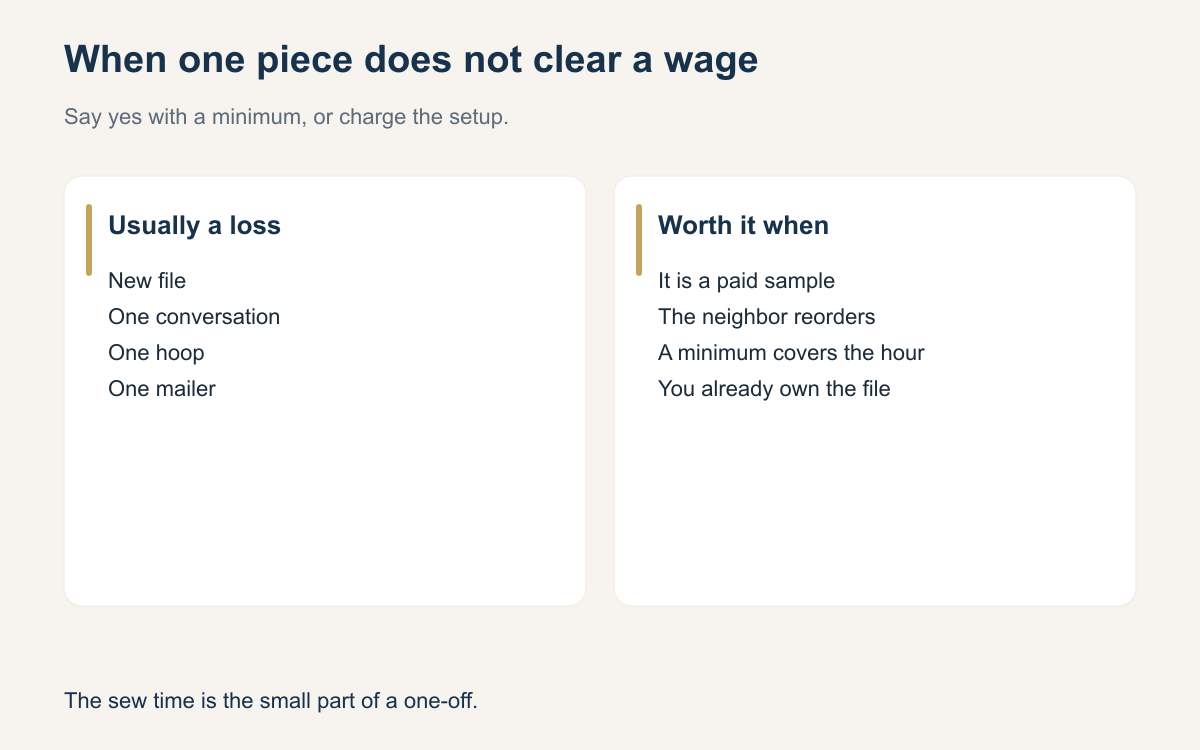
A one-piece order feels like easy money because the machine is only busy for a few minutes. Then you count the messages, the file, the packing, and the photo you send so they believe it is done. Many single pieces do not clear a wage once those minutes are on the clock. The piece can still be worth sewing. It has to be priced as one piece, not as one hundredth of a hundred-hat order.
The figures below are an illustration with round numbers. Your inbox may be faster and your digitize bill may be higher. Run the minutes on your last single hat before you decide the whole category is good or bad. Some one-piece work is a sample that earns a reorder. Some is an hour you gave away because you did not have a minimum.
What one piece actually takes

Illustration: messages 20 minutes, hoop and sew 20 minutes, pack and a photo 10 minutes. That is 50 minutes before a new file. At a shop rate of 36 dollars an hour, 50 minutes is about 30 dollars of labor. Add a blank you supply at 10 dollars, materials at 1, a bag at 1, and a new digitize at 40. The stack is about 82 dollars. If they hoped to pay 25, you are not having a pricing debate. You are deciding whether to fund their hat.
Take the digitize away and let them bring the garment. Labor 30, materials 1, a bag 1, about 32 dollars, and you still carry the risk of a garment you do not stock. A 25 dollar payment might almost cover a low rate and still leave nothing for a mistake or for profit. This is the version shops call "quick." It is quick on the machine and ordinary everywhere else. If your rate is 50 dollars an hour, the same 50 minutes are already over 40 dollars before the blank. Use your rate. The 36 dollar illustration is only a stand-in.
When a single piece is worth sewing
Sew one piece when it is a sample for a reorder the customer has already described. Charge a sample price that covers the time, and say what happens next. In this illustration the sample fee is 40 dollars, and 20 of it comes off a reorder of 12 or more if they place it within 30 days. You are not sewing a hope at no charge. You are selling a sample with a deadline. If they never reorder, the 40 still paid the hour. If they do, you already know the file and the placement.
Sew one piece for a neighbor or a regular, and still use the minimum. Friendship is not a discount that goes below the wage. You can choose a smaller profit term for someone who sends you a team every season. You should not choose a price that loses the hour and calls it community. The neighbor who respects the shop will pay a minimum. The one who only calls for a single emergency hat at a bulk price is not a relationship. They are a leak with a familiar name.
A minimum that lets you say yes
A minimum is how you say yes without donating the hour. Try this sentence, then change the dollars to yours: "The minimum embroidery charge is 45 dollars for one piece when the stitch file already exists. A new logo adds digitizing, which is its own fee. I can sew one, and the price is the minimum, not the per piece price from a larger run." The illustration of 45 assumes a short sew, a file you already have, and a garment in hand at a modest rate. If your 50 minutes need 60 dollars, the minimum is 60. Raise it until the clock and the price agree.
Say the minimum before you ask what they want sewn. People can accept a floor when it arrives early. They fight a floor that arrives after they heard a bulk price and did the math for one hat. Put the sentence on your quote message so you can paste it. You are allowed to sew the piece. You are not required to sew it at the 100-hat rate. Those are different products.
- Fifty minutes is a fair illustration for messages, sewing, and packing on a calm one-off.
- At 36 dollars an hour, that is about 30 dollars of labor before the blank.
- A new file in this illustration adds 40 dollars, and a supplied hat can push the stack into the low 80s.
- A sample can be worth it: 40 dollars, with 20 credited to a 12 piece reorder within 30 days.
- Minimum sentence: 45 dollars when the file already exists. If 45 misses your clock, raise it.
- Decline a complex logo, due tomorrow, priced like a bulk hat.
When to say no anyway
A minimum does not fix a risky job. A new complex logo, one piece, due tomorrow, at a bulk price, is a decline or a full quote. A garment you have never hooped, especially the only one they own, is not saved by a 45 dollar floor. Refuse same-day complex art, one-of-a-kind goods, and a bulk price on a quantity of one. Three minimum-fee hats can fill gaps. A whole week of them crowds out the order where setup is shared.
How to keep the hour
Write the minimum and the refuse list next to the machine. "I can do one when the file already exists. The minimum is 45, and a new logo is quoted before I start." Then track five single pieces: minutes, price, and whether they reordered. If none reorder, tighten the minimum. If two become real reorders, the sample fee is doing its job.
Price one piece as one piece. Add the messages, the sew, and the packing, put a new file on its own line, and set a minimum that covers that clock. Use a sample fee with a reorder credit when the single piece is really a test for a larger job. Say no when the minimum still cannot cover the risk. The illustration numbers are a rehearsal. Your last five single tickets are the test.
A question for the group
What is your minimum charge for a one piece order, and which single piece jobs are you still willing to sew at that minimum?