
Pricing
One hat versus 100 hats
Setup is paid once. One hat carries the digitize, the first hoop, and the conversation. One hundred hats spread that setup, so the per piece price should fall and then flatten. A linear discount will eventually cut through the blank. The schedule below is an illustration.
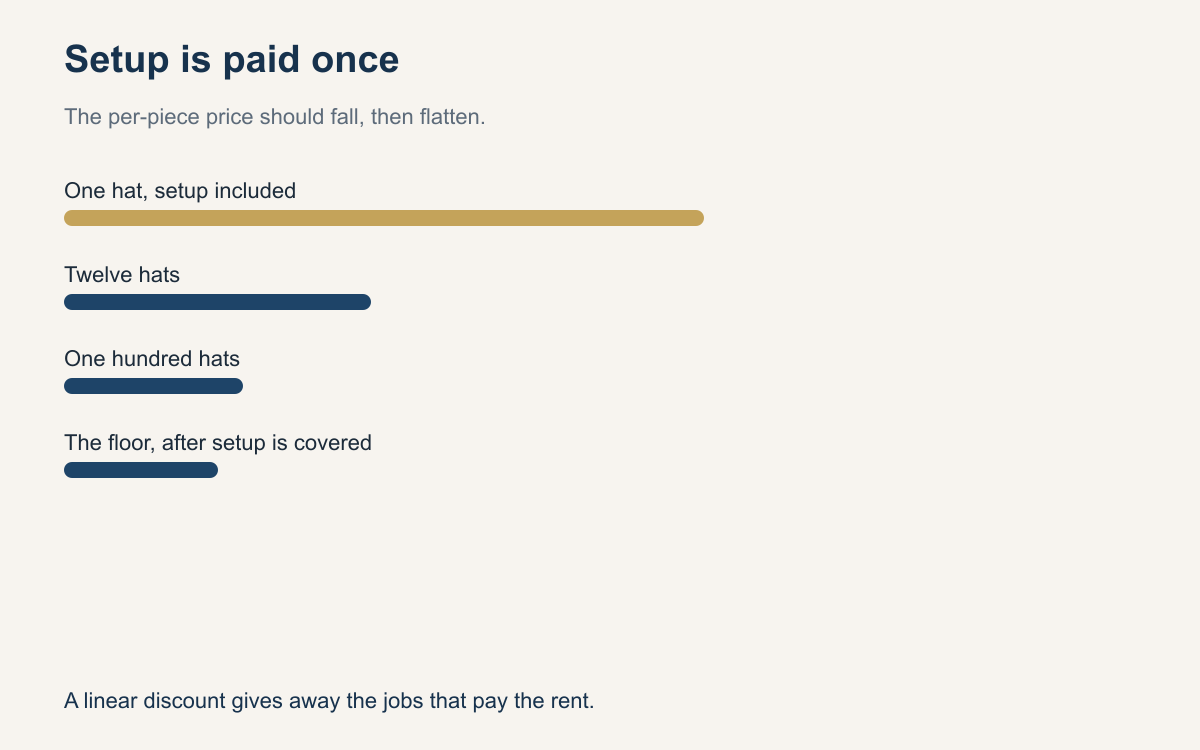
One hat and one hundred hats are not the same job with a zero added. The digitize, the proof conversation, and the first hoop are paid once. The hundredth hat still needs a blank, thread, backing, and the minutes to sew and bag it. A fair quantity price falls while setup is being shared, then flattens when the only costs left are the ones that repeat. A straight line discount does not know when to stop, and it will walk you under the wholesale of the blank.
The dollars below are an illustration with round numbers. Replace the setup pool, the blank, and the sew minutes with your own. The shape is what you keep: a high price at one piece, a real drop by a dozen or two, and a floor you will not cross no matter how large the order looks on paper.
What you pay once
Build a setup pool before you talk about per hat price. In this illustration the pool is 100 dollars. Digitizing a new logo is 60. The proof and the conversation are 30 minutes, and at 40 dollars an hour that is 20. The first hoop, a test sew, and a spacing fix are another 20 of time. None of that work shrinks because the customer said "and can you do a hundred." It is the same hour whether they buy one hat or a case.
One hat carries the whole pool. In the illustration the variable cost of a hat is separate: a 9 dollar blank, 1 dollar of thread and backing, and 12 minutes to sew, trim, and bag. At 40 dollars an hour those 12 minutes are 8 dollars. Variable cost is 18 dollars. One hat then costs about 118 before profit: 100 of setup plus 18. A sell price with a little room might be stated near 140. That is not a punishment. It is the job.
How the per piece price falls
Spread the same 100 dollar pool and watch the piece price move. At 12 hats the setup is about 8 dollars each, plus 18 of variable cost, so cost is about 26 and a sell price with margin might sit near 34. At 24 hats setup is about 4, cost about 22, sell near 28. At 48 hats setup is about 2, cost about 20, sell near 26. At 100 hats setup is 1 dollar each, cost about 19, sell near 25. These sell prices are an illustration of a modest margin on top of cost, not a chart to photocopy.
Read the gaps, not just the prices. From 1 hat to 12 the illustrated sell price falls hard, because a 100 dollar pool hurts a single piece and barely shows on a dozen. From 12 to 24 it falls again, smaller. From 48 to 100 it moves about 1 dollar. That last step is the flatten. You are no longer sharing a big setup. You are sewing one more hat that still costs a blank and 12 minutes. Another hundred hats, from 100 to 200, splits a 1 dollar setup share into 50 cents. It is not a new discount tier.
Why the discount is not a straight line
A linear discount pretends every quantity step is the same kind of savings. Start at 40 dollars and subtract 5 at each break: 40, then 35, then 30, then 25, then 20. By 100 hats you are at 20 dollars. In this illustration the cost at 100 is already about 19 before a real profit, and one missed blank wipes the dollar you had left. The straight line did not know that the blank was 9 and the sew was 8. It only knew how to keep cutting.
Quantity discounts belong on the setup you are no longer repeating, not on the blank you still buy. "Half off at 100" is a request to donate hats. If someone wants the one-hat price cut in half, show them the pool divided by their quantity and the variable cost that does not move. You can be generous with the setup share. You cannot be generous with wholesale and still reorder blanks next month.
- Setup pool in this illustration: 100 dollars, paid once.
- Variable cost per hat: 18 dollars, blank plus materials plus sew time.
- One hat, cost about 118, illustrated sell near 140.
- Twelve hats, cost about 26 each, illustrated sell near 34.
- Twenty-four hats, cost about 22 each, illustrated sell near 28.
- Forty-eight hats, cost about 20 each, illustrated sell near 26.
- One hundred hats, cost about 19 each, illustrated sell near 25.
- From 48 to 100 the sell price barely moves. That is the floor.
- A straight cut of 5 dollars per tier keeps falling after the floor and eats the blank.
- Do not discount the blank below what you paid for it.
The reorder is a different pool
If you keep the file, the next order does not carry the 60 dollar digitize. The pool might be 40 dollars instead of 100 in this illustration. Prices fall a little and still flatten at the same variable cost. Write two schedules: new file, and same file. The second starts lower and hits the same floor. A minute saved per hat on a long run is under 1 dollar at 40 an hour. Do not invent a 30 percent cut because the machine feels faster. Most of the hat is still fabric you purchased.
How to say the schedule
Publish a few quantities and a floor. In this illustration: 12 hats are 34 each, 24 are 28 each, and 48 or more are 26 each until the blank cost changes. The sentence that matters is the floor: "Past 48 the price does not keep dropping, because each hat still has a blank and a sew."
If they want a quantity you have never run, price it from the pool and the variable cost, then check the floor. Do not extrapolate the discount. A 200 hat order is the 100 hat price, maybe a dollar less if you truly save handling, not a new cliff. Write the schedule on one card. When you are tired you will be tempted to make a linear promise. The card is there so you do not.
Add up what you pay once, divide it by the quantity in front of you, and add the blank and the sew that never go away. Let the per piece price fall while that division is doing real work, then stop. Mark the stop as a floor and say it out loud. Replace this illustration with your digitize bill and your last blank invoice. A hundred hats is a good order when the floor still feeds the shop. It is a bad order when the discount kept walking.
A question for the group
Where does your per piece price stop falling, and what quantity is the last one you are willing to discount?