Tools
Five ways AI helps an embroidery shop
AI can draft a customer reply, smooth a product description, caption a real sew-out, format a checklist, and sort a messy email. It does not replace the person who decides density, underlay, and whether the file should sew.
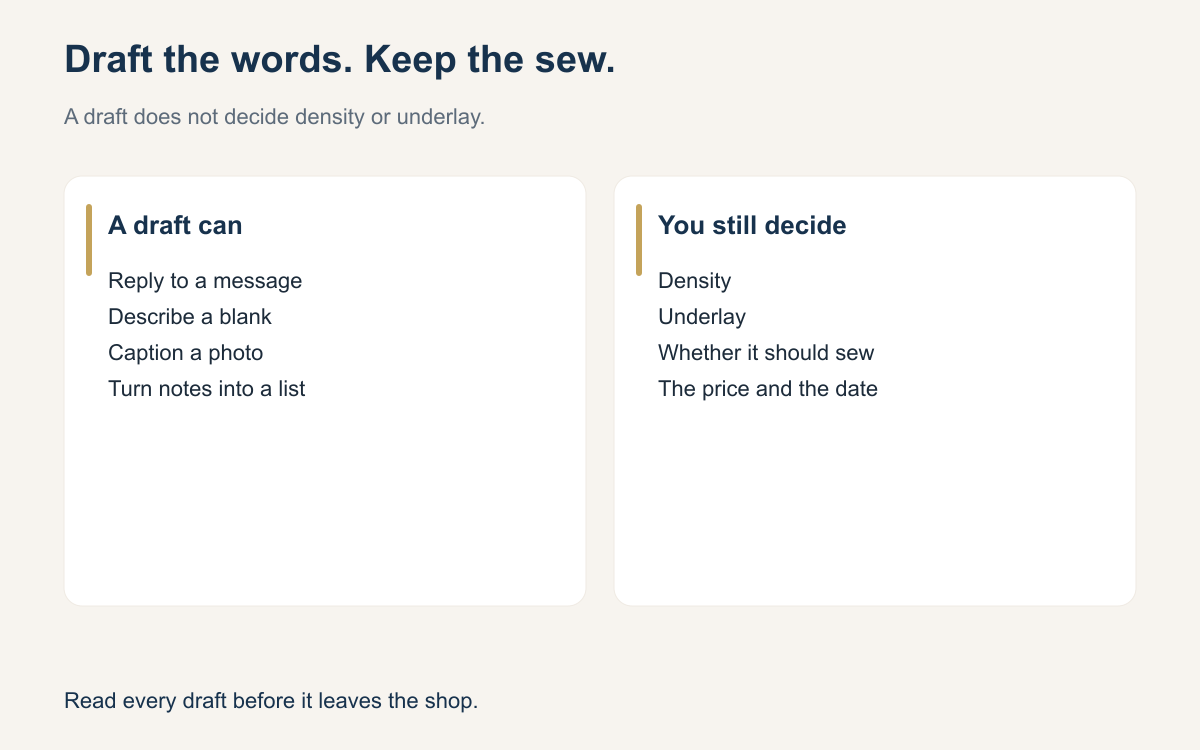
AI is useful in an embroidery shop the way a fast assistant is useful: it can turn a pile of words into a cleaner pile of words. It can draft the reply you have typed a hundred times, turn your notes about a blank into a paragraph a buyer can read, and pull the quantity out of an email that wandered for six paragraphs. That saves real minutes on a night when you would rather be hooping.
It does not know your machine, your backing shelf, or the polo that puckered last Tuesday. AI does not replace the person who decides density, underlay, and whether the file should sew. Treat every draft as a draft. You still set the price, the date, and the sew plan. The five jobs below are office work. The needle plan stays with you.
Draft the reply, then you set the facts
Customer replies are the first place a draft earns its keep. Paste the question and your usual facts: the placements you offer, the turnaround in business days, and the art file types you can use. Ask for a short reply in your tone. You will get a decent paragraph in seconds. Then you edit. Put in the real price from your chart. Put in a date you can hit. Delete any sentence that promises a rush, a color match, or a detail you did not offer.
Do not send the draft raw. A raw draft sounds helpful and commits you to things you did not decide. Read it once as the buyer and once as the person who has to sew it. If a line would be awkward to honor on Thursday, cut the line. The tool wrote a suggestion. You wrote the offer. That split keeps the speed and keeps the shop out of promises made by a paragraph you did not check.
Turn shop notes into a product description
You already know how a blank behaves. The pique is stable. The performance tee needs cutaway. The cap is structured and the front panel is the only place you will sew. Those notes are gold, and they often sit in a half sentence on a packing slip. A draft can turn them into a product description a buyer can finish reading: fiber, fit, where you sew, and what you will not sew.
You still have to supply the truth. If the tee puckers when the design is wide, the description should say you keep chest marks small, or you should not sell that tee. AI can smooth grammar. It cannot tell you the fabric will misbehave. Read the paragraph against the last sew-out of that blank. Delete any claim about softness, durability, or speed that you would not say to a buyer standing at the counter.
Caption a photo of work you actually sewed
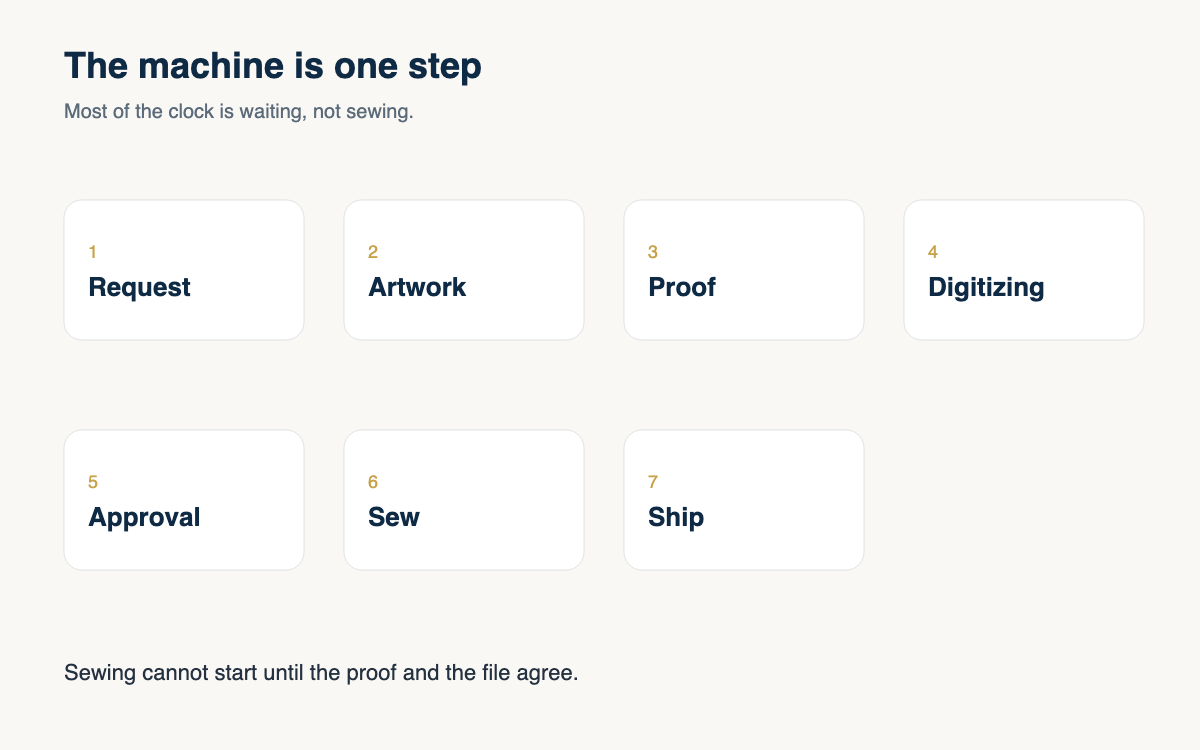
A social caption is a small piece of writing on top of a photo of real work. Give the draft the true details: the kind of blank, the placement, and a public fact such as a team season or a shop opening, without private names if the buyer did not agree. Ask for a short caption. You will spend your time deleting, which is faster than staring at a blank box after a long sew day.
Refuse captions that inflate the shop. No claim that you digitized a photograph into a portrait. No claim that every order ships the next morning. No claim that you sew any garment in any size. The photo is the proof. The caption should help a similar buyer recognize themselves. If the draft adds a service you do not sell, that line goes. Your name is on the account. The draft does not have a reputation to lose, and you do.
Turn your real steps into a checklist
A checklist is how a tired evening still ships a correct box. You already have the steps in your head: art in, proof approved, blanks counted, hoop, trim, names checked, pack, label. A draft can format that list, add a box to tick, and split receiving from packing so you are not holding one long paragraph. Ask it to use only the steps you typed. Then read the list out loud against the way the bench actually runs.
Delete steps that belong to a different shop. Add the step you always forget, such as confirming the spelling on the name list before you hoop the first shirt. A checklist that includes a fantasy step, like a quality lab you do not have, will train you to skip the whole list. The tool is a formatter. The sequence is yours. Once the list is right, print it or keep it where you pack, and stop rewriting it from memory on every order.
Sort a long email into the order facts
The messy email is a booster note that mixes a question about thread color, a complaint about last year, a list of sizes, a new deadline, and a story about the fundraiser, all in one block. You can spend twenty minutes parsing it, or you can ask a draft to sort it into facts: quantity, garment color, sizes, placement, date, and the actual question. You still answer the question. You still decide if the date is possible.
Check every fact against the original. Drafts drop numbers and merge two sizes into one. Highlight what is missing, such as a file or a yes on placement, and reply with only those gaps. Sorting is the help. Judgment is still the job. If the note asks you to make the mark sew itself, close the draft and open the file the way you always have. Density, underlay, and the choice to sew stay with you.
- Let a draft write the reply, then put in the real price and the real date.
- Turn your blank notes into a description and delete any claim you cannot sew.
- Caption a photo you took, and cut any service you do not offer.
- Format a checklist from steps you already trust, then add the step you forget.
- Sort a messy email into quantity, color, sizes, placement, date, and the question.
- Keep density, underlay, and the decision to sew in your hands, not in the draft.
Use the five drafts this week if they save you time: the reply, the description, the caption, the checklist, and the messy email. Read every one before it leaves the shop. AI does not replace the person who decides density, underlay, and whether the file should sew. That person is you. The words can be helped. The hoop cannot be delegated to a paragraph.
A question for the group
Which of the five office tasks ate your time last week, and which sew decision will you still refuse to hand to a draft?