
The industry
What is harder, finding customers or managing orders?
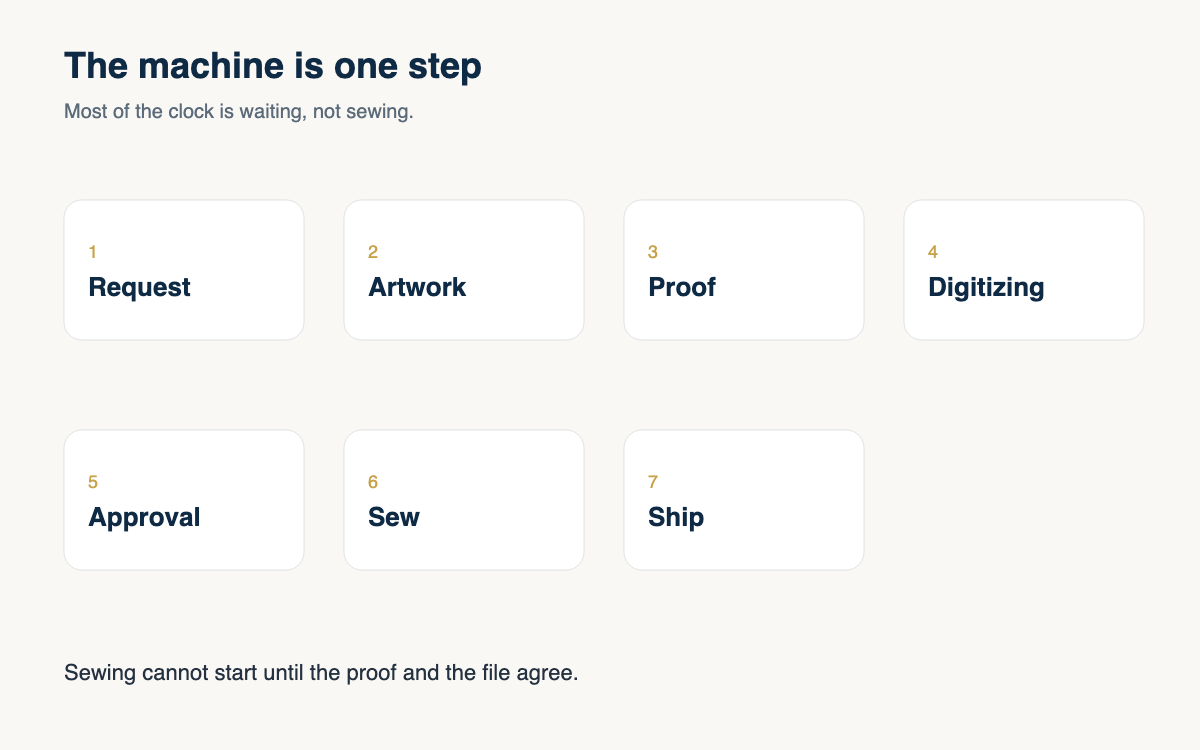
Early on, the hard part is finding someone who will pay you to sew. Later, the hard part is quotes, approvals, and files with no home. The machine is rarely the bottleneck in either stage. Name the stage you are in this month before you buy a fix for the other one.
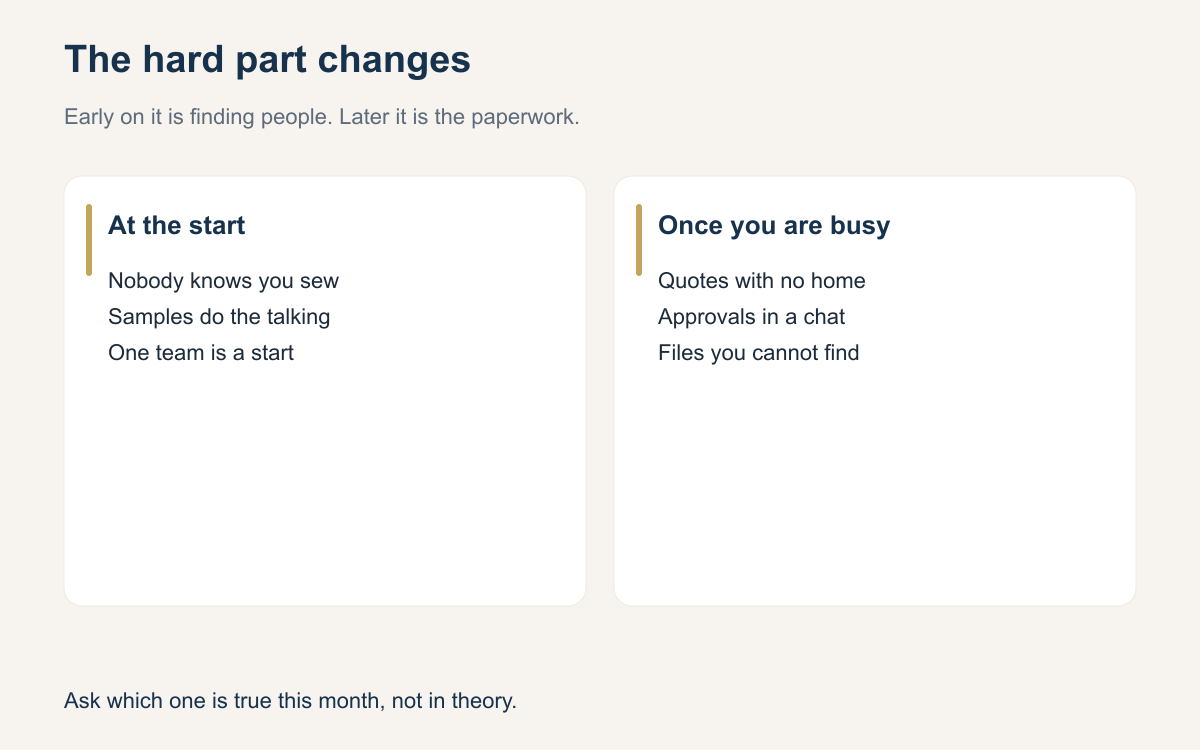
Ask a new shop what is hard and they will say customers. Ask a shop that has been slammed for a year and they will say the paperwork, even if they never use that word. Both answers are right. They are true at different times. A tidy folder does not help an empty calendar. Hunting more customers while twenty quotes sit in a text thread will keep you overwhelmed.
The switch is gradual and easy to misread. A slow week can be three approvals you never wrote down. A busy week can be a file named final on one desktop. Name the stage before you print more cards or buy another head.
Early on, nobody knows you sew
At the start, almost nobody knows you sew. Friends might. A buyer searching for a cap will not pick you over a shop with photos and a price they understand. The machine can be excellent and still sit. That is the order of the work, not a verdict on your skill. You have to be found, then trusted, then asked, before production skill matters.
Comparing yourself to a full shop in this stage pushes bad purchases. You do not need more needles to look open. You need a clear offer, a blank you sew well, and a way for a person in town to see a finished cap. The bottleneck is attention and trust. Treat it that way until the calendar argues with you.
How to find the first real customers
Pick one offer you can say in a sentence. A dozen caps, one color, your blank, ready on a date you can hit. Take that sentence to people who already buy decorated apparel: a coach, a shop on your street, a clinic that replaces polos, a restaurant with a faded logo. Bring a sample you sewed. Ask what they reorder and when. A conversation without a date does not pay the hoop.
Follow up once, on purpose, about a week later. Send the photo of the sample and the same one-sentence offer. Most early customers do not say yes in a parking lot. They say yes when the season is close and your note is the one they can find. Do this for a month before you decide the town has no work. A month of asking beats a year of posting into silence.
Later, quotes and approvals pile up
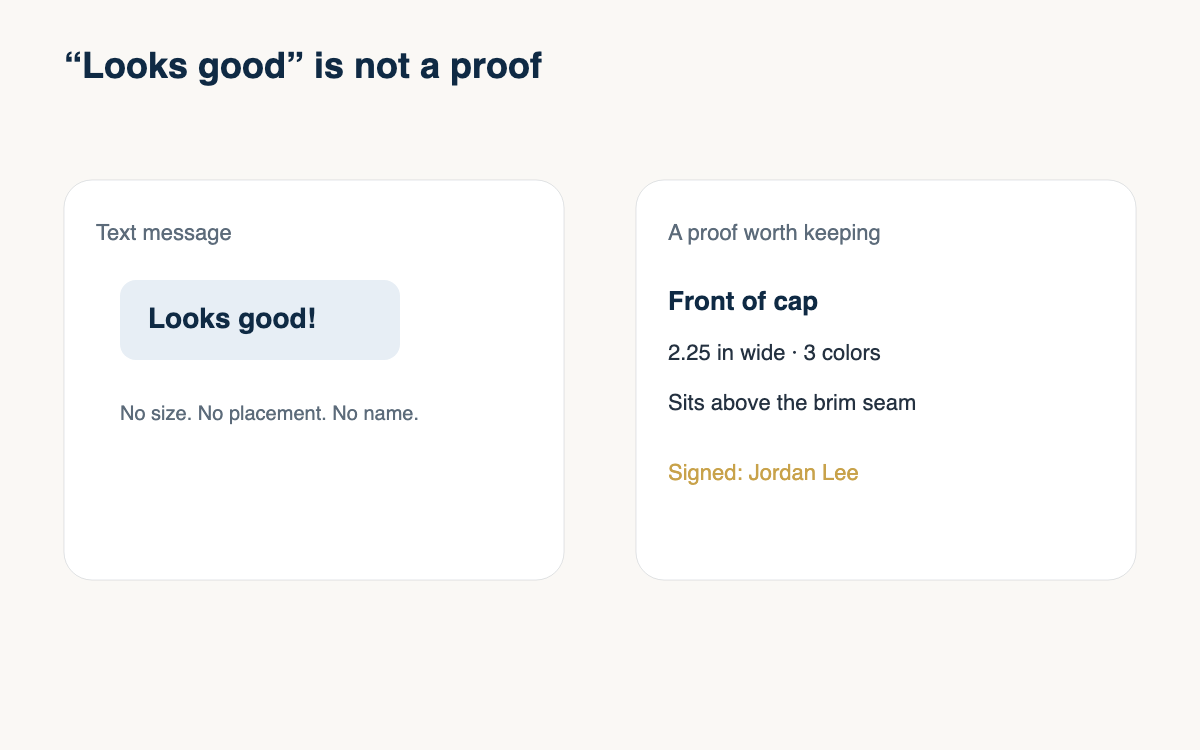
Once people know you, the pile changes. Quotes live in texts. Someone says the proof is fine in a thread you cannot search. A price from a phone call never lands on the order. You sew from memory and redo the job when the memory was wrong. Finding more customers at this stage makes the pain worse. Every new yes is another loose end if the yes has nowhere to live.
The fix is dull and it works. One place for the quote, with the blank, the count, the placement, and the price. A yes you can find later, in writing, attached to that quote. A rule that you do not hoop until the saved yes is the one you are sewing. You will feel slower for a week, and you will stop redoing work you cannot quote back. Speed returns when you stop guessing.
Files that live nowhere
Art arrives in a message. A sew file sits on a USB stick. Another version is called final on a desktop only you can open. When you are busy, this is how the wrong logo gets sewn and how a reorder becomes a reconstruction. The customer thinks you have the mark. You have twelve things named logo, and none of them are tied to the order.
Give every job one home, and put the approved art and the sew file there before you hoop. Name them with the customer and the date, not with the word final. A reorder should open that record and sew without a treasure hunt. A labeled folder beats a clever system you do not use. Another person should be able to find the file if you are out.
Spend the next ten hours on the real stage
If you are early, spend the next ten hours on customers, not on a process for orders you do not have. Make the sample. Visit buyers who already purchase uniforms or team goods. Say one price for the simple job, the same way every time. Photograph your own sew-outs. Measure success by conversations that have a next date.
If you are later, spend those hours on the pile. List every open quote, every missing yes, and every job whose file you cannot find in two minutes. Close or schedule each one. Then keep the rule: no hoop without a written yes and a file in the job home. More customers can wait until that list is short. Demand on top of lost files turns a good month into a bad story.
Tell the two problems apart this week
Look at this week, not at your identity as a hustler or a craftsperson. If the machine is idle and the phone is quiet, you have a customer problem even if the filing is messy. Tidy a little, and spend the real time in front of buyers. If the machine is idle and the phone is full of people waiting on you, you have an order problem. They already found you. You are the delay.
If both feel true, split the day. Morning for open quotes and files. Afternoon for one customer conversation. Do not let guilt about finding people erase the approvals, and do not let approvals become a reason to hide from new people for a month. The stage can be mixed. The fix is still specific. Name the job in front of you before you buy a solution for the job you wish you had.
- Early: one sentence offer, one blank, and several talks with people who already buy apparel.
- Early: a sample you sewed, then a follow-up about a week later with a date attached.
- Later: every quote in one place, with blank, count, placement, and price.
- Later: a written yes you can find, and no hooping until that yes is the one on the job.
- Later: one home for the approved art and the sew file, named by customer and date.
- This week: idle and quiet means go find customers. A full phone means clear the pile first.
Finding customers is harder at the start. Keeping quotes, approvals, and files straight is harder once the work shows up. Neither problem is solved by pretending you are in the other stage. Look at the machine and the phone. Idle and quiet means go talk to buyers. Idle and crowded means write the yes down and give the file a home.
A question for the group
Which one feels harder in your shop this month, finding the next customer or keeping the quotes, approvals, and files straight, and what would you change first?