
Growing the shop
Where an embroidery shop should sell
Etsy, Shopify, and a site you own each charge you in a different way. Fees, who keeps the buyer, traffic you rent or earn, how hard customization is, and orders that arrive as messages should decide where the next sale lives.
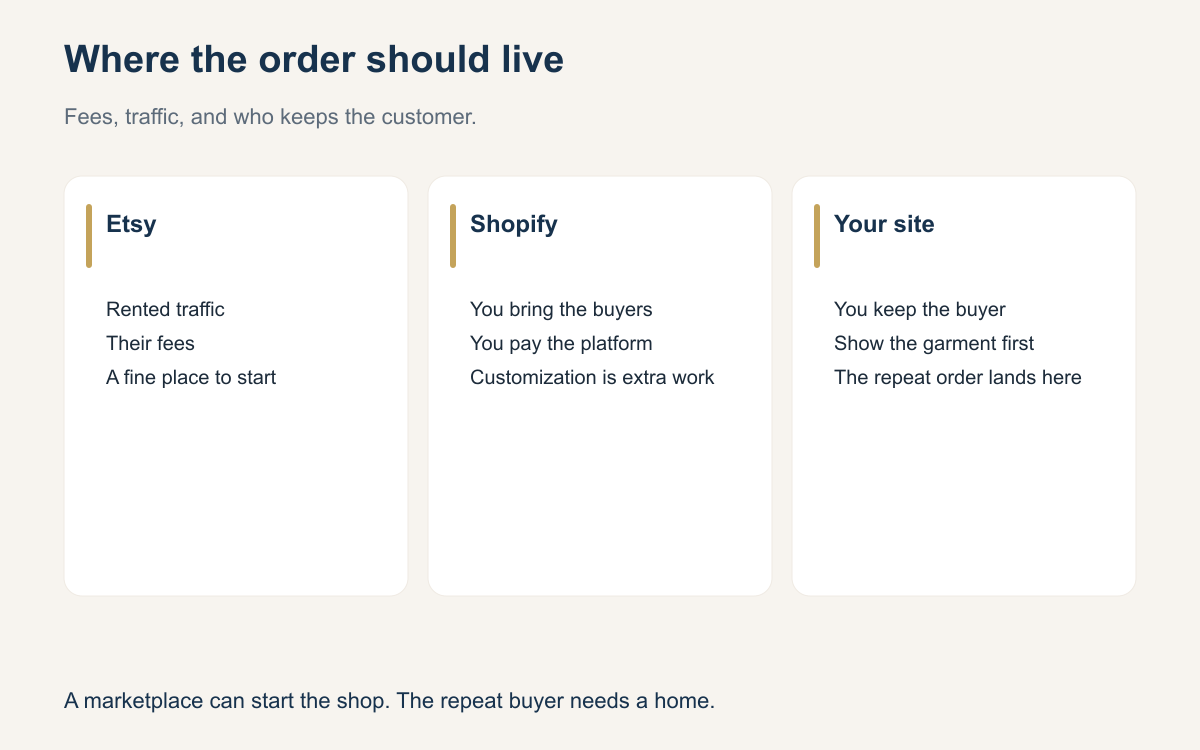
Where you sell is not a personality test. It is a set of costs and a set of jobs. A marketplace can put a stranger in front of a hat you embroidered. A shop platform can give you a checkout and a list of names. A site you run yourself can show the garment the way you actually sew it. None of those is free, and none of them is wrong for every stage of a shop.
Be fair about the start. If you have no audience, a marketplace can be the first place orders come from, and that is a real gift while you learn your prices. The mistake is treating that first door as the only door. The buyer who orders again should land somewhere you control, where the second hat does not depend on a search box and a message thread.
Fees are the rent, not the whole bill

On a marketplace like Etsy you pay to list and you pay a percent of the sale, plus the cost of taking the card. You are renting a crowd that is already shopping. On Shopify you pay a monthly subscription and a payment fee. You are renting tools, not a crowd. On a site you own, the cash fees are often smaller: a domain, hosting, and a way to take cards. The bill shows up as your time instead.
Compare the whole bill, not the line you dislike. A marketplace fee can be worth it when it buys an order you would not have found. A low hosting bill is not a bargain if you spend every evening retyping specs out of a chat. Write down, for one normal cap, what you paid in fees and what you paid in minutes. That pair of numbers is the real cost of the channel.
Decide who keeps the buyer
A marketplace account belongs to the marketplace. You may not be allowed to email that person next season the way you would email your own list. The next order often starts as another search, and you hope they remember your shop name. You did the work. The relationship is borrowed.
A Shopify shop and a site you own keep the name, the order, and the permission to write again if you asked for it properly. That is where a repeat buyer should land. The second sale can be a short note with a photo of the last sew-out and a price for the same thing. You cannot build that habit if every reorder has to be discovered from scratch inside a search run by someone else.
Traffic you rent and traffic you earn
Rented traffic is the visitor a marketplace sends, or the click you bought with an ad. It is useful, and it stops when you stop paying or when the search rules change. You do not get to complain that the rent went up. You chose a lease. Use it to learn which blanks and which prices actually sell, then do not bet the whole shop on the lease.
Earned traffic is slower. A coach bookmarks you. A search page starts to rank. A team from last year gets a note from you, not from a marketplace. That stream is smaller at first and it compounds. A practical shop uses rented traffic to start and spends some of each week on the earned kind: one page that explains a blank, one note to a buyer you are allowed to contact, one photo of real work with a way to reorder.
Custom work fights a listing form
Embroidery is a placement, a blank color, a size, and a file, not a single dropdown. A marketplace personalization box is often one line of text. The real spec spills into messages: left chest, navy, no tagline, need it Friday. Shopify can hold variants, and the grid explodes. Color times size times placement times thread becomes a form nobody finishes. The note at the end becomes the real order, which means the form failed.
A site you own can be built around the way you sew. The buyer sees the garment, chooses a placement you actually hoop, and sees a price you already believe. That is harder to set up than a listing, and it is the version that fits custom work. If a channel cannot show those three things together, you will keep selling by conversation, and conversation does not scale past the hours you have at night.
A message is not an order you can hoop
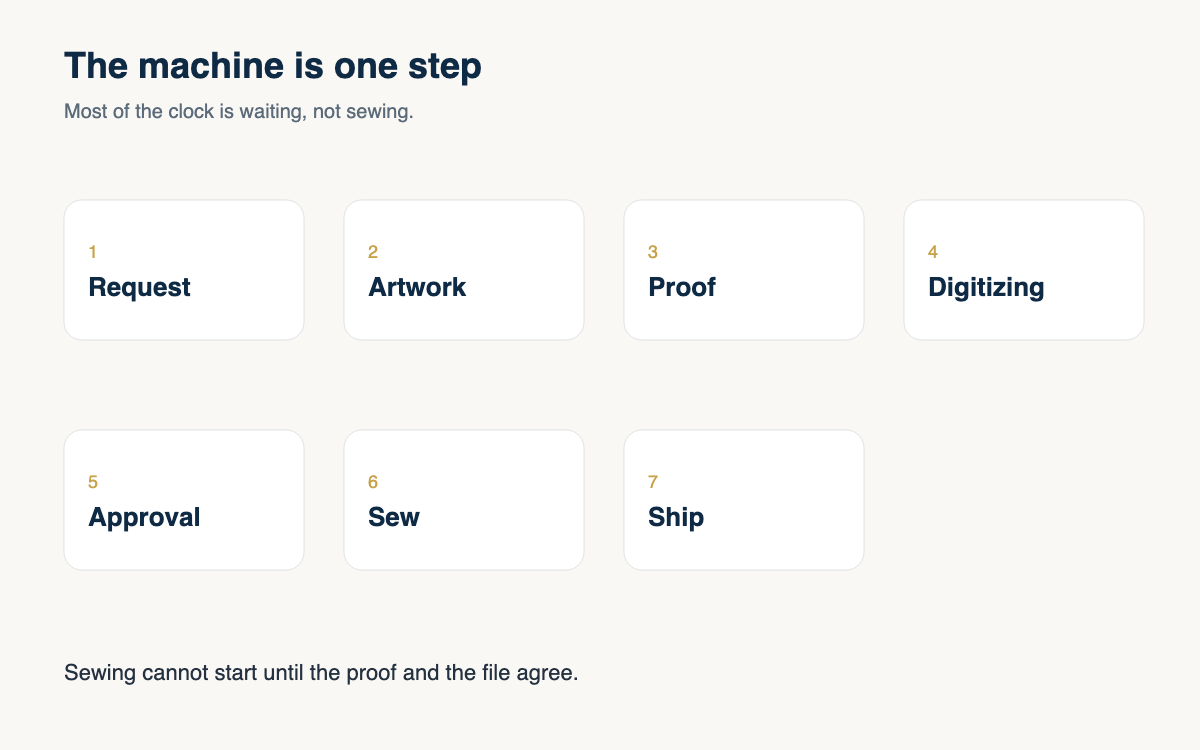
An order that arrives as a message often looks like this: twenty four black polos, logo on the left, names on the right, need them Friday. It is missing sizes, a file the machine can sew, a yes on placement, and a payment. You rebuild it. You guess a chest width. You chase the art. That labor never appears in the fee schedule, and it is where mistakes are born.
Treat a message as a lead, not as a spec. Reply with the missing pieces in one note, and do not hoop until the blank, the placement, the file, and the money are settled. Channels that force the spec into chat will keep costing you even when the percent looks small. The useful fix is a path where those facts are collected before you sew, whether the person found you on a marketplace or on a page you wrote.
- Use a marketplace to get first orders when you still have no audience.
- Keep a record of every buyer you are allowed to contact again.
- Move repeat work to a site you control.
- Do not treat a chat message as a complete sew spec.
- Count the minutes you spend retyping an order as part of the fee.
- Match the channel to the job instead of swearing loyalty to one logo.
Start where the buyers already are if your list is empty. Learn the blanks and the prices there. When the same people order again, give them a door that is yours, so the second order is a confirmation and not a scavenger hunt. Rent traffic while you need it. Earn the relationship on a site you can still open if a marketplace changes the rules tomorrow.
A shop can sell on a marketplace and still keep a site it owns. The useful version of that site shows the garment, the placement, and the price before anyone pays, and the shop keeps the order instead of rebuilding it from a message. Stitchify Hub is one way to run that storefront next to the production record. Where you sell is still your choice.
A question for the group
Where did your last five repeat orders actually start, and which of those buyers have a way to reorder that does not depend on a marketplace inbox?