Pricing
Embroidery, DTF, or screen printing for small orders
On a small order, embroidery wins on perceived value and durability for logos. DTF can be cheaper on full color art and low quantities. Screen printing wants volume. The 12 piece comparison below is an illustration, and the winner depends on the art and the quantity.
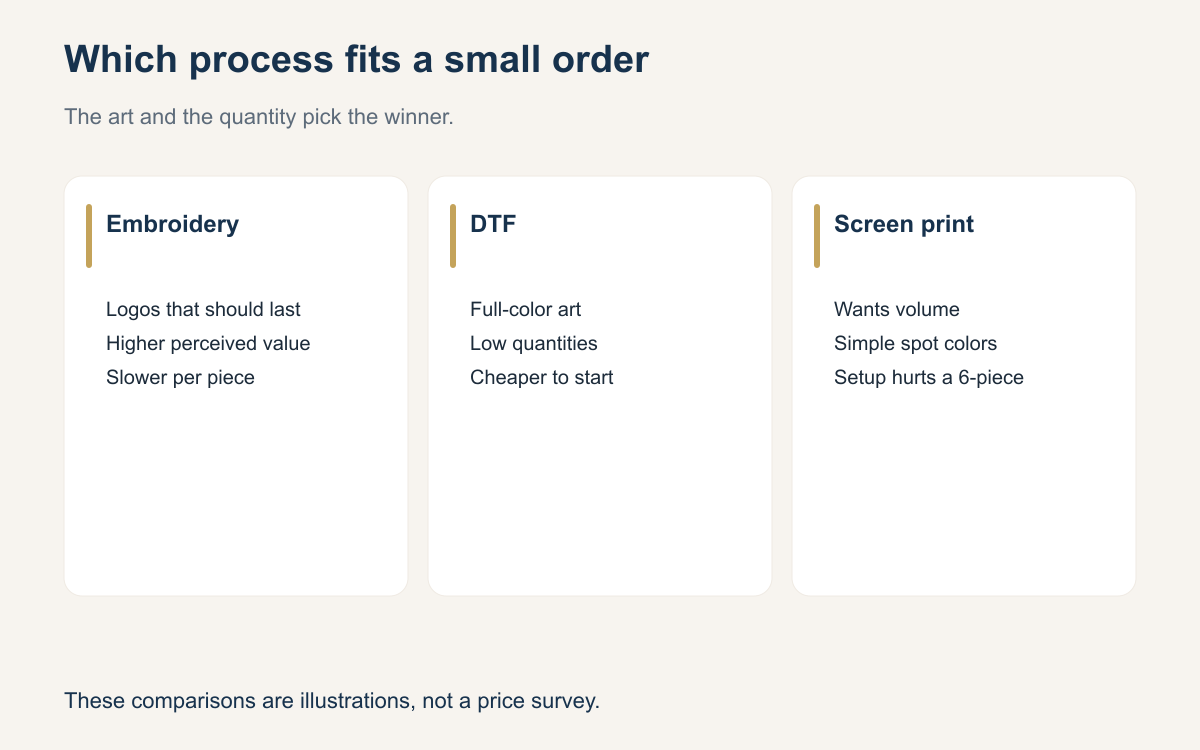
A customer asks for twelve shirts and sends art that might be a logo, a photograph, or four spot colors. The machine you own is not the answer by itself. Embroidery wins on perceived value and on durability when the art is a logo. DTF can be cheaper, and often better looking, when the art is full color and the quantity is low. Screen printing wants volume so the screens stop dominating the piece price. Pick the method from the art and the quantity, then price that method.
The comparison below is an illustration with round numbers for 12 pieces and a shared blank at 8 dollars a shirt. It is not a quote, not a national average, and not a reason to buy equipment. Replace every figure with your decorator, your press, or your printer. The winner in your shop is the method whose real stack fits the art in front of you.
Embroidery on a small logo run
Illustration for 12 left-chest logos. A new simple digitize is 48 dollars, which is 4 dollars a shirt. Sew labor and materials are 6 dollars a shirt. Decoration is about 10 dollars a shirt. Shirt plus decoration is about 18. The customer is paying for thread that looks like a uniform, survives washing, and feels finished on a polo or a hat. That perceived value is why a higher piece price can still be the right sale. You are not losing to a cheaper method if the cheaper method is a different product.
Embroidery loses the comparison when you force it to imitate a photograph. Tiny detail, gradients, and a dozen colors turn the 6 dollar labor line into a long, fragile sew, and the digitize stops being 48 dollars. If the art needs to stay a picture, do not win the argument by sewing it badly. Say that thread is the wrong tool for this art at this size. Offer a simpler logo in thread, or move the picture to a method that can hold it. Your honesty is the thing they remember when the next order is a real logo.
DTF when the art is full color
DTF, a direct-to-film transfer you press, is often the small-order tool for full color. Illustration for the same 12 shirts: 3 dollars for the transfer and 2 dollars to press, so decoration is about 5 dollars a shirt. There is no embroidery digitize. Shirt plus decoration is about 13. The gap versus the embroidery illustration is about 5 dollars a shirt on decoration, and the art can be a photo. That is a real advantage at low quantity. It is not a moral failing to use it or to send it to a press you trust.
Name the limits with the price. The hand feel is a film, not thread. It is often the wrong face for a cap logo, and it is not the wash story of stitches on a work polo. On a hoodie with a full color picture, DTF can be the better product and the cheaper one. "This art is full color and the run is 12, so I would press it" is a clear recommendation.
Screen printing wants a bigger pile
Screen printing puts money in the screens before the first shirt looks finished. Illustration: one color, 36 dollars of setup, which is 3 dollars a shirt on 12 pieces, plus about 2 dollars of ink and labor, so decoration is about 5. That can sit near the DTF illustration for a simple mark. Three colors at 36 dollars each is 108 dollars of setup, 9 dollars a shirt before print labor. Add about 3 dollars to print and handle, and decoration is about 12, which is more than the embroidery decoration in this picture, while the buyer still reads embroidery as the more expensive-looking mark.
Volume is the point of screens. The same 108 dollar, three-color setup on 48 shirts is a little over 2 dollars a shirt. That is where spot color starts to make sense. At 12 pieces, a multi-color screen job is a setup bill wearing a shirt. Ask the quantity and the color count, and include what your printer actually charges you.
- Shared blank in this illustration: 8 dollars. Only decoration changes.
- Embroidery, 12 simple logos: decoration about 10, garment about 18. It wins on a durable logo.
- DTF, 12 full color shirts: decoration about 5, garment about 13. It can hold a picture.
- Screen printing, one color at 12: decoration near 5. Three colors at 12: decoration about 12.
- That three-color setup on 48 shirts falls to a little over 2 dollars a shirt.
- The winner depends on the art and the quantity. Replace every figure with your bills.
A way to choose without a debate
Ask three questions. How many colors at the real size? How many pieces? Does this need to survive a year of washing as a logo, or stay a picture? Logo, few colors, hat or polo: embroidery, with the digitize priced honestly. Full color under a few dozen: DTF is allowed to win. One or two spot colors at 48 and up: screen printing. You can offer both prices when the art could go either way, a simpler logo in thread and the full art pressed. Let them pick the product.
What not to do with the equipment you own
Owning an embroidery machine is the wrong reason to sew a photograph. Send the photo to a press and keep the machine for logos. If you offer all three methods, keep your own 12 piece numbers and update them when a bill changes. Recommend the method whose story matches the art.
Lay the art next to the quantity and choose before you price. Embroidery for the logo they will wear for a year. DTF for the full color piece at a low count. Screen printing when the pile is big enough that the screens calm down. Use your own round numbers, label them as yours, and do not let a borrowed chart pick a method the art cannot survive. The winner is allowed to change on the next order. That is the point.
A question for the group
For a 12 piece logo order, which method would you choose, and what would the art have to look like before you switched?