
Pricing
An embroidery pricing formula for a small shop
Price equals blanks, plus materials, plus labor minutes times your shop rate, plus digitizing if the file is new, plus a share of overhead, plus the profit you actually want. One worked example below uses round numbers and is only an illustration.
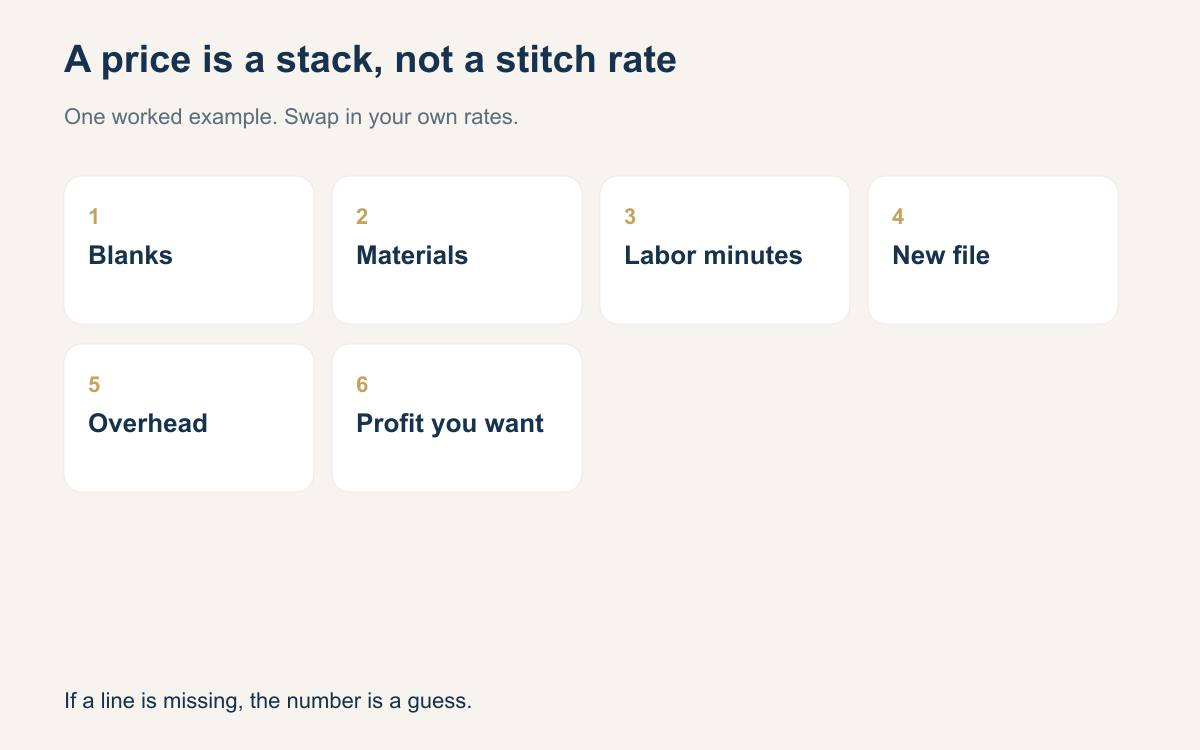
You do not need a new theory of pricing. You need a formula you can reuse on a Tuesday when someone is waiting. Price equals blanks, plus materials, plus labor minutes times your shop rate, plus digitizing if the file is new, plus a share of overhead, plus the profit you actually want. Every term is a number you can point at. If a term is a shrug, the price is a guess wearing a dollar sign.
The worked example is an illustration with round numbers: 12 polos, a new left-chest logo, a shop rate of 40 dollars an hour. Your blanks may be 14, your sew may be 20 minutes, your rate may be 55. Replace every input. The formula is the part that stays. It is not a universal law and it is not a quote you should send unchanged.
The six terms, in order
Blanks are what you pay the supplier, times quantity, including sizes you had to buy that you cannot return. Materials are thread, backing, topping, bags, and the other bits you throw away per piece. Labor is minutes, not a vibe: setup and conversation once, plus hoop, sew, trim, and fold per piece. Multiply those minutes by the shop rate, the dollars per hour the shop needs for wages. Digitizing is the next term, and it is zero when the file is already saved. Overhead is a share of rent, insurance, software, and the hours you are open but not sewing. Profit is the last term, the amount you want left after the wage inside the rate.
Write it on a card in that order. People drop overhead first, then profit, then the minutes that are not the machine running. The card is there so a friendly customer does not get a price made of only blanks and hope. You can round the final total to a number that is easy to say. You should not round by deleting a term. Rounding 377 to 380 is fine. Deleting the 75 dollars of profit and calling it rounding is how the formula dies.
A worked example for 12 polos
Illustration, round numbers, 12 polos. Blanks are 8 dollars each, so 96. Materials are about 1 dollar a shirt, so 12. Labor minutes: 30 minutes of setup and conversation, plus 12 minutes to hoop, sew, trim, and fold each shirt. That is 30 plus 144, which is 174 minutes. Call it 180 minutes so the illustration stays round. The shop rate is 40 dollars an hour, and 180 minutes is 3 hours, so labor is 120 dollars. The file is new, so digitizing is 50 dollars. Before overhead and profit the subtotal is 96 plus 12 plus 120 plus 50, which is 278.
Overhead in this illustration is 2 dollars a shirt, 24 dollars, standing in for a shop that has about 800 dollars a month of rent and fixed bills and sews about 400 pieces. Cost is then 302. Profit you actually want, in this illustration, is 25 percent of that cost, about 75 dollars. Price is 302 plus 75, which is 377, and you can say 380 dollars for the 12, about 32 dollars a shirt. If your rent is the same and you only sew 100 pieces a month, the overhead share is closer to 8 dollars a piece and the price moves. The formula does not care that you dislike that number.
What each term is not
The shop rate is not profit if you set it as the wage you need to pay yourself or a hire. Many shops put 20 dollars an hour in the formula, feel noble, and then wonder why a full calendar still cannot pay rent. If 40 dollars an hour already feels like "the money," decide on purpose whether the profit term is extra or whether you are willing to live on the wage alone. Living on the wage alone is a choice. Forgetting the profit term and hoping is not a choice. It is a leak.
Digitizing is not a tax you add because you feel like it, and it is not zero just because you enjoy making files. In the example it is 50 dollars because the file is new. On a reorder of the same file it is 0, and the price drops by that 50, about 4 dollars a shirt on 12 pieces. That is a real reorder discount: the work went away. A discount that also cuts the blank is a different, usually worse, idea. Overhead is not optional because you work from a spare room. The spare room still has a light bill, a machine payment, or both.
- Blanks: 12 polos at 8 dollars, 96 dollars in this illustration.
- Materials: about 1 dollar a shirt, 12 dollars.
- Labor: about 180 minutes at 40 dollars an hour, 120 dollars.
- Digitizing, new file: 50 dollars. A saved file would be 0.
- Overhead share: 2 dollars a shirt, 24 dollars. Replace that with your month.
- Profit in this illustration: about 75 dollars.
- Price you might say: 380 dollars for the 12, about 32 dollars a shirt.
Minutes are the term you must time
Twelve minutes a polo is an illustration for a calm left chest. A cap, a jacket, or a design with many trims can be 20 minutes. On 12 pieces that extra 8 minutes is 96 minutes, over 60 dollars at 40 an hour, that you did not quote. Time three pieces. The 30 setup minutes cover messages. If revisions take an hour, grow the labor term or charge an edit fee. Untimed work is how a profitable-looking order feels poor.
How to use it without a speech
You do not have to show all six terms. You do have to run them. Say the total, keep the terms on the ticket, and set digitizing to zero on a reorder of a saved file. If the blank price went up, the quote changes with it. When a finished job paid worse than you hoped, put the real minutes back into the formula. The gap is the leak. Close it on the next job by changing colors, using a saved design, or stocking a blank you already trust. Fewer pieces is the wrong direction.
Copy the six terms onto a card and price the next order from the card, top to bottom. Use your blank invoice, a clock, your real hourly need, your real digitize cost, a share of the month that does not sew, and a profit number you would be glad to keep. The 12 polo illustration is only a rehearsal. When your total surprises you, believe the total long enough to change the quote. The formula works when you stop negotiating with the terms you dislike.
A question for the group
Which number in the formula are you guessing right now, the shop rate, the overhead share, or the profit you actually want to keep?