
Techniques
Embroidery on stretchy fabrics
Polos, athletic wear, and stretch tees need cutaway, a relaxed hoop, underlay, lighter density, a look at the grain, and topping when the face is pique. Stretch the shirt in the hoop and the logo will pucker after it comes off.
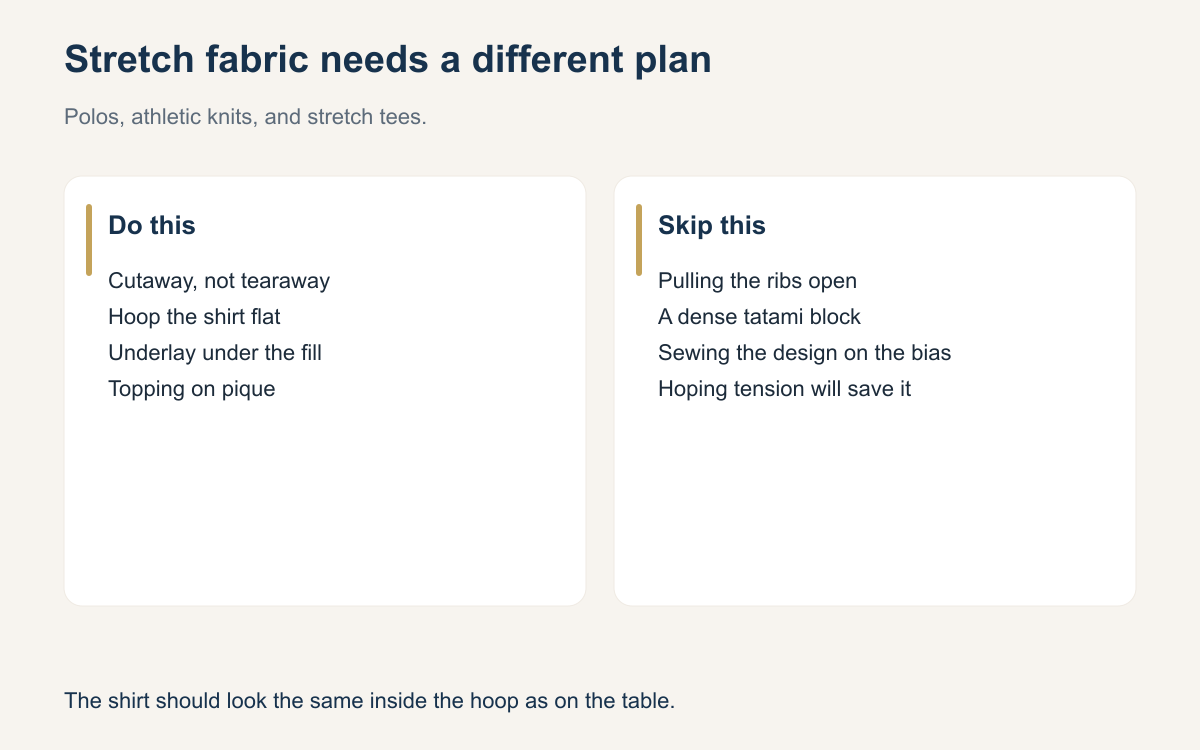
Stretch fabric is most of what a shop sews now. Polos, athletic jerseys, and tees with elastic in the knit all move when someone puts them on. A design that looks perfect on the machine can ripple the moment the hoop opens, because you sewed the shirt in a shape it does not keep. The fix is not a secret tension number. It is how you hold the cloth, what you put under it, and how heavy you let the stitches get.
Treat every stretch blank as guilty until a sample says otherwise. A polo that feels firm is still a knit. A performance shirt that looks smooth is still trying to recover. The steps below are the ones that keep the chest flat after the garment is worn, not only while it is trapped in the ring. Skip one of them and the others have to work harder than they should.
Start with cutaway
Cutaway is the backing for polos, athletic wear, and stretch tees. It stays in the shirt and shares the pull so the stitches do not gather the knit into a ring. Tearaway can look fine while the hoop is closed and then leave the logo unsupported. If you remember one rule for stretch, make it this one. The sheet that stays is the sheet that works. The sheet you tear out is for fabric that does not move.
Match the weight to the shirt. A heavy cutaway under a light jersey boards the chest. A mesh cutaway that is too light under a big fill lets the knit creep. Trim the cutaway so it does not show at the neck or past an open placket, and leave enough that the stitches are not hanging on the last thread of the sheet. When the design sits high on a thin athletic shirt, a lighter no-show mesh cutaway is often the version that supports without announcing itself.
Do not stretch the fabric in the hoop
The most common stretch mistake is hooping the shirt tight because tight feels secure. You are sewing a stretched shape. When the ring comes off, the knit returns and the stitches, which do not return, pull the logo into waves. Hoop the fabric relaxed. It should look like the shirt on the table, only held. Ribs should not be pulled open. A stripe should not grow wider inside the ring.
If the hoop will not close without a tug, float the shirt or use a hoop that fits. Drum-tight fabric shines. Relaxed fabric looks ordinary. After the sample, pull the shirt the way a person pulls it on. If waves show up, you stretched it or the design is too stiff. Fix that sample before the stack.
Underlay and density
Underlay ties the knit down before the top stitches drag across it. On a polo or a stretch tee, a zigzag or a double run under satin, and an open fill underlay under a fill, stop the fabric from creeping row by row. Skip the underlay and the first satin pass becomes a tow rope. Letters halo. One side of the design pulls tighter than the other. Put the underlay in for this fabric. A file that was digitized for a jacket often has less underlay than a knit wants, or the wrong kind.
Then lower the density. Extra stitches are extra holes, and on a knit those holes line up into a tear. An open fill with underlay will look cleaner than a dense fill that turns the chest into a patch. If a test square cups or rips when you tug it, the fill is still too heavy.
Consider the grain
Knits do not stretch the same amount in every direction. A polo often moves more across the chest than it does from shoulder to hem. A wide satin column that runs across the stretch locks the shirt at one width. The rest of the cloth wants to move. You get a bar of stitches with ripples on either side. When you can, aim long satin with the more stable direction, or break a wide column into a shape that does not span the whole stretch in one pull.
Customers usually want the logo straight, so compensate instead of rotating it. More underlay, less density, a shorter design, and cutaway that can carry the job. Tug the shirt both ways before you hoop. The direction that grows is the one you should not lock with a long, dense column.
Topping on pique
Pique is a stretch knit with a texture. The backing solves the movement. The topping solves the ribs. A water-soluble topping on the face keeps satin and small fills from sinking into the pique so the stitches sit where you can see them. Without it, a fine column looks broken and a light color looks speckled with the shirt. Athletic mesh and some performance faces need the same help when the surface is not flat.
Topping is in addition to cutaway, not instead of it. Hoop them with the shirt relaxed, tear the extra topping off, and trim the cutaway. Do not skip the cutaway to save a step. A pretty surface on a puckered shirt is still a return. The polo usually needs both.
Sew one shirt as the test
Stretch shows up after the hoop, after a tug, and after a wash. A sample that you only look at on the machine is not a sample. Sew one piece of the actual order, or a scrap cut from the same goods, with the cutaway, the relaxed hoop, the underlay, the density you intend to ship, and topping if the face is pique. Take it off. Tug it. If you can wash it, wash it. Then decide.
If the sample waves, do not steam it and sew the stack. Steam hides a pucker until the shirt is worn. Change the hoop, the backing, or the file, and sew the test again. One tight hoop copied twenty times is twenty bad shirts.
- Use cutaway on polos, athletic wear, and stretch tees.
- Hoop relaxed. A wider stripe means you stretched the shirt.
- Add underlay under satin and under fills.
- Drop density until a test square survives a tug.
- Do not lock the stretchy grain with a long dense column.
- Put water-soluble topping on pique.
- Tug the sample before you sew the rest of the stack.
Stretch fabric forgives a careful hoop and punishes a tight one. Cutaway underneath, the shirt at rest in the ring, underlay in the file, density that still lets the knit flex, a glance at the grain, and topping when the face is pique. Do those on one shirt and read the result in your hands. The order can follow the sample. It should not teach you the sample.
A question for the group
What is your rule for hooping a polo so the chest stays flat after the first real wear?