
Pricing
Embroidery jobs that look profitable and are not
Five jobs look fine on the invoice and still lose the day: a complex logo with endless colors, a customer who revises, a difficult fabric, a rush, and a one-off on a garment you have never hooped. Price each one for the mess, or decline it. Amounts below are an illustration.
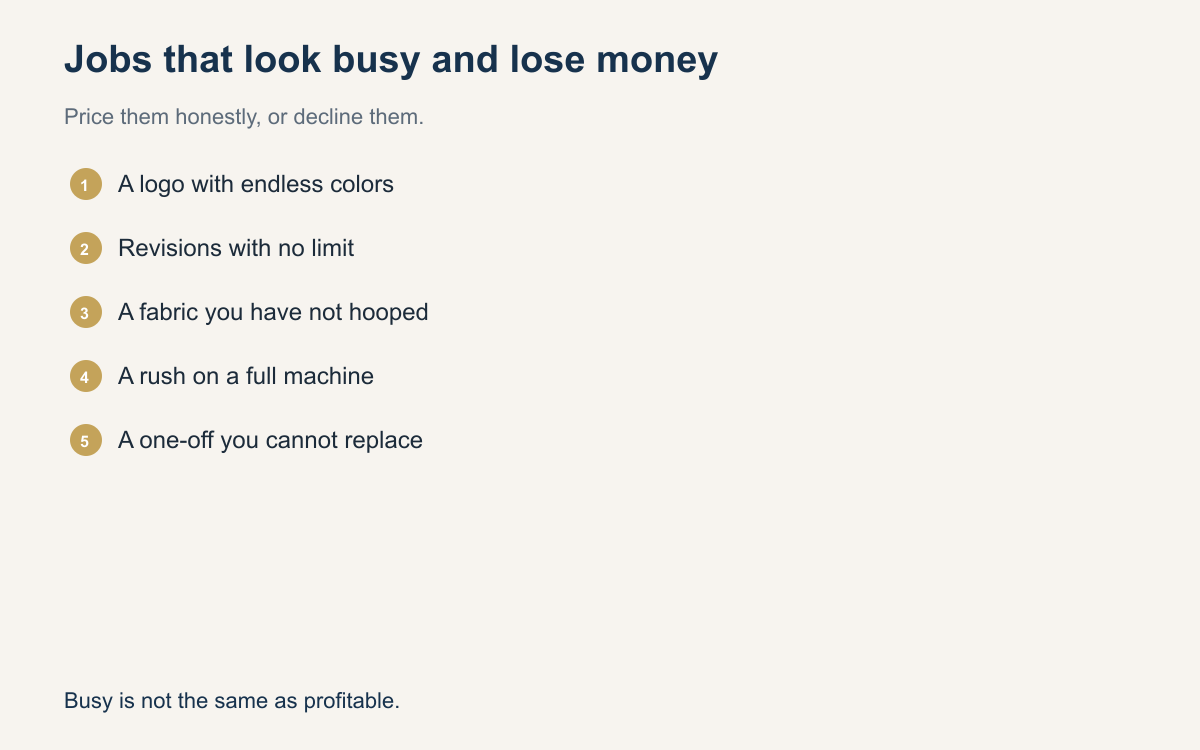
Some jobs look profitable because the stitch count is normal and the blank was marked up. Then the day disappears into color changes, a third proof, a fabric that will not behave, a rush that jumps the queue, or a garment you have never hooped. The invoice still shows a profit that never reached the drawer. These five are the usual leaks. None of them is rare. All of them have a price or a refusal.
Every dollar below is an illustration with round numbers, not a fee schedule for every shop. Use the shape: if the job is longer, riskier, or more interruptive than your normal price assumes, change the price or decline. Looking only at the stitch count is how a full day ends short while the paperwork looked fine.
The logo with endless colors
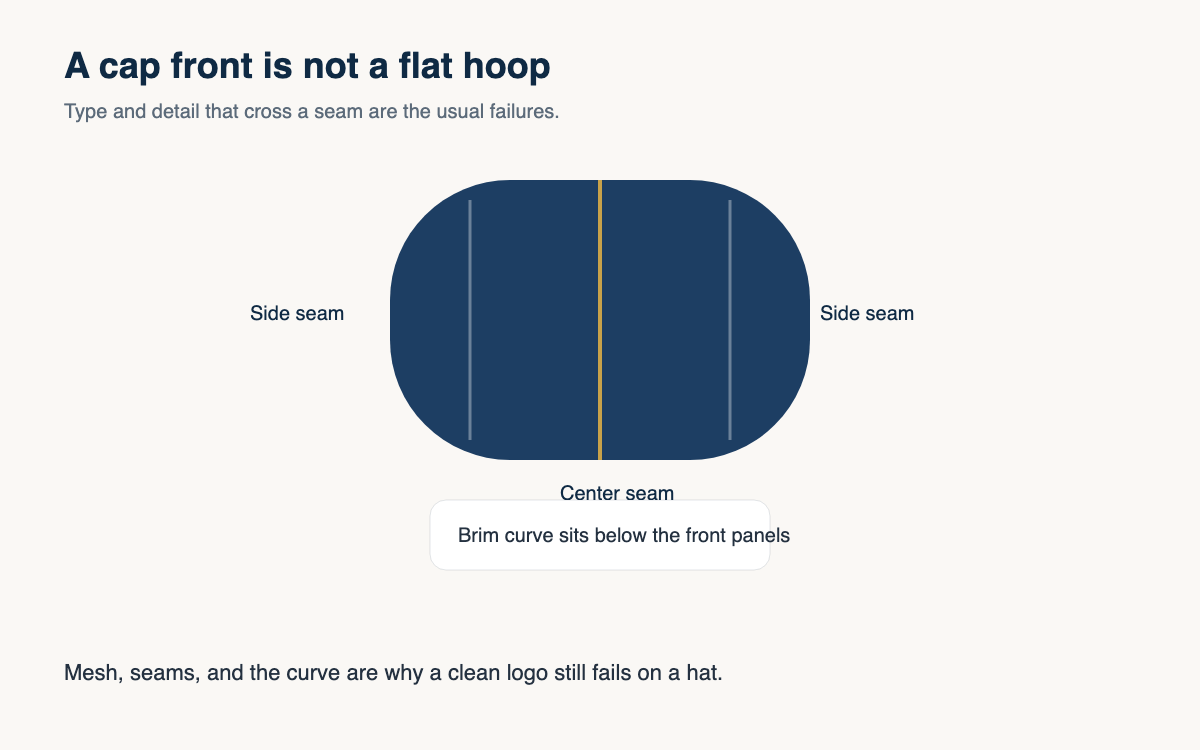
A 12 color crest on a cap is not a standard logo with a bigger number. Every color is a trim, a chance to misread at cap size, and time you do not spend on the next hat. Digitizing might be two hours. Sewing might be 40 minutes instead of 15. Illustration: your usual hat labor is 18 dollars, and this sew is 40 minutes at 40 dollars an hour, so labor alone is about 27, plus a digitize near 90. Quote it as a specialty or cap the colors. Do not sew the photo-style mark and hope it looks like the file on the phone.
Say a limit before you open the art program. "I sew up to 6 colors on a cap. Past that, the design needs to be simplified or the price moves to a complex-logo rate." Then offer the simpler version next to the original. The one that still reads at arm length is the one to sew. If they will not simplify and will not pay the specialty rate, decline. A hairy sew-out you have to remake is the opposite of profit, even when the first invoice looked clever.
The customer who revises
You sent a proof. They changed the word, then the icon, then the color. Each round is messages plus a file edit, and none of it is the sew you already priced. Illustration: the first proof and one revision sit inside the digitize fee. After the second proof, each new round is 20 dollars, due before you edit. If they will not stop, you sew the last approved version or you close the order. Endless revision is how a 50 dollar file becomes an evening you cannot bill.
Use a sentence with a stop in it. "I can make one more change for 20 dollars, and then I sew what you approve." Send it when round two arrives, not after round five, when you are already angry. Approval means a clear yes to a picture, not a text that says "looks good but." If the yes never comes, you do not owe an infinite file. A customer who pays the edit fee is a customer. A customer who treats your evening as a workshop is a job to close.
Difficult fabric and the rush
Puff, nylon, a thin performance knit, a soft baby garment, a cap that is mostly mesh: the test sew is the job. Illustration: a test fee of 15 dollars on scrap, or on one garment they accept might be sacrificed. If you will not risk it, decline in one line. "I do not sew this fabric." A 12 dollar sew on a 40 dollar performance shirt is a bad trade when the shirt wrinkles into a ring around the logo. Price the difficulty as extra minutes you have timed, or do not hoop it. Curiosity is not a quote.
The rush is a different leak. Six hats for Saturday, asked on Thursday night, will jump a batch you already priced. Illustration: a rush fee of 25 dollars on the order, or 5 dollars a piece, and only if you want the night. If you do not, "I can sew this on Tuesday" is a complete answer. Name the fee or name the date.
- Endless colors: cap the palette or use a complex-logo rate. Illustration: labor near 27 and digitize near 90, against 18 of normal labor.
- Revisions: one change inside the fee, then 20 dollars a round, paid before you edit.
- Difficult fabric: a 15 dollar test on scrap, or decline.
- Rush: 25 dollars on the order or 5 a piece, or say the real date.
- A first hoop: a 30 dollar sample fee, and say the first piece is the test.
- If you have never sewn that blank, practice on goods you bought before you hoop theirs.
A garment you have never hooped
A tote with a pocket in the way, a beanie, a bag with a seam through the center, a jacket placket: the first one takes an hour of figuring and may be scrap. Your normal left-chest price does not contain that hour. Illustration: charge a first-time sample fee of 30 dollars on top of sewing, and say that the first piece is the test. If the test fails, the fee paid the learning and you do not owe a perfect heirloom. Better, decline until you have bought that blank yourself and sewn it on a morning with no audience.
Do not learn a new hoop setup on a customer only jacket. The lesson will cost more than the fee if the jacket is the one they cannot replace. Pair this with the supplied-goods rule: if you do not stock it and you have never hooped it, the answer is no, or the answer is a test on a blank you can ruin. Skill grows on purpose, on goods you bought, not as a surprise inside a customer order.
A refuse list you can read when you are tired
Write the five jobs on a card: too many colors, another revision, a fabric you do not trust, a rush, a first hoop on their only piece. Next to each, write the price or the word decline. After a month, notice which one you still sewed at the old price. That is the leak. Use the new sentence for two weeks without a "just this once." The invoice is not the profit. The week is.
Run the next questionable job past the five before you say yes. Endless colors, revisions, a fabric you fear, a rush, or a hoop you have never done: each one gets a higher price or a no. Replace the illustration fees with numbers that cover your real extra hour. A job that looks profitable and is not will keep looking that way until the card is louder than the customer hurry.
A question for the group
Which of these five jobs have you already sewn at a loss, and what will you charge or decline the next time it shows up?