
Designs
When appliqué is the right embroidery design
A large, simple shape does not have to be a solid field of stitches. Appliqué lets fabric do the fill, with thread holding the edge.
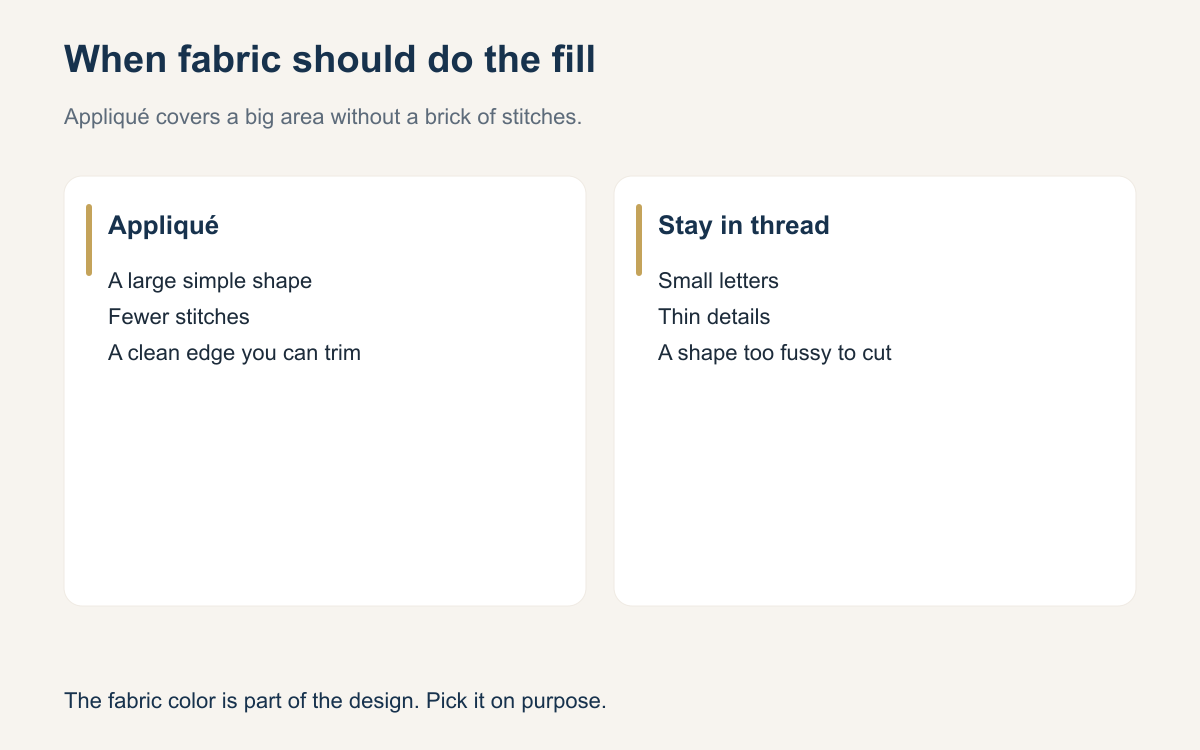
Appliqué is a piece of fabric, cut to a shape and held down with stitching. It is not a shortcut for a detailed logo, and it is not “easier embroidery.” It is a design choice. You use it when a shape is large, simple, and better as cloth than as a brick of fill stitches. A team name across a jacket, a big initial, a simple mascot body: those are the jobs where appliqué saves sew time and keeps the garment soft.
It fails when the shape is fussy. Every notch, ear, and thin tail is a place the edge stitch can chew the fabric or the trim can look ragged. If you would not trust yourself to cut that shape cleanly, do not appliqué it. Sew it in thread, or simplify the shape until the cut is honest.
Use it when the fill would be a brick
A solid fill large enough to read across a room is a lot of needle penetrations. It takes time, it can pucker, and it can make a sweatshirt feel armored. Appliqué covers that area with cloth. The machine sews a placement line, you lay the fabric down or it is already hooped in a stack, and a satin or a dense zigzag tack the edge. The middle of the shape is fabric, not stitches. That is the whole advantage.
The fabric you appliqué is part of the color story. A felt initial in the school color will not match a thread chart exactly, and it does not have to. Pick it in the light you will show the customer, on top of the blank, before you cut a stack. Cheap fabric puckers at the edge and frays past the stitch. Use a material that does not unravel faster than your edge stitch can cover, and test one before you promise a dozen.
The edge is the design
People look at the middle and judge the outline. A satin border that is too narrow will not cover the cut edge, and raw fabric will wink out after a wash. A border that is too wide swallows a small shape and rounds off corners you meant to keep. Set the border for the fabric: wider and denser on something that frays, cleaner and a bit narrower on a stable felt or twill that cuts sharp.
Plan the trim. Appliqué still wants underlay or a placement stitch so the fabric does not shift, and it wants a stop where a person can place or trim. If your process is “cut after sewing,” leave enough seam allowance and teach the trim. A sloppy cut is more visible than a slightly simple shape. If your process is precut pieces, the cut has to match the stitch file, not the other way around. One sample, fully trimmed, tells you which process you actually have.
Do not appliqué the details
Names, thin outlines, eyes, and small numbers belong in thread on top of the appliqué or instead of it. Trying to cut a letter with a counter, like an O or an A, out of fraying cloth is how shops learn to hate appliqué. Sew those in satin. Use appliqué for the shield, the block, or the background, and embroider the word on top if the word is large enough to read.
Also skip appliqué on placements that cannot hold a stack of fabric. A cap front can take a small, firm appliqué if you have done it before and the shape is simple. A tiny chest logo does not gain anything from a piece of cloth and a border. The border alone may be wider than the design. When the shape is small, sew it. Appliqué earns its place when the alternative is a large fill.
Price the handling, not only the stitches
Appliqué often has a lower stitch count and a higher handling cost. Someone cuts, places, and trims. If you quote it like a small fill because the stitch count dropped, you will lose the time in the cutting. Price the piece: the appliqué fabric, the minutes to cut and trim, and the edge stitching. A repeat order with a die or a precut stack is cheaper than the first one. Say so, or you will charge the wrong price on both.
Tell the customer what they are getting. “The body of the mark is fabric, with a stitched border and an embroidered word.” Some people want every inch in thread because they think fabric looks less expensive. Let them see a sample. A clean appliqué on a jacket looks intentional. A huge fill that puckers looks like you were afraid to use fabric. The sample ends that argument faster than a description.
- Use appliqué for large, simple shapes, not for thin details.
- Choose fabric that will not fray past the border.
- Make the edge stitch wide enough to cover the cut.
- Keep letters and small parts in thread.
- Price the cutting and trimming, not only the stitch count.
- Show one trimmed sample before you run the set.
Appliqué is a design you choose when cloth will do a better job than a field of stitches. It asks for a simple shape, a border you can trust, and time to trim. Used that way, it keeps big marks soft and readable. Used on a fussy logo, it makes a mess with extra steps.
The next large one-color shape you quote, ask whether it should be fabric with an edge instead of a fill. If the answer is yes, price the hands as well as the needle.
A question for the group
Which shapes do you trust as appliqué, and which ones did you try once and go back to sewing entirely in thread?