
Pricing
How to stop losing money on customer-supplied garments
A garment the customer brings can hide a stain you did not make, and a sew-out you cannot replace because you do not stock the blank. Charge a risk fee or refuse the job, and put the rule in writing before the bag hits the counter. Figures below are an illustration.
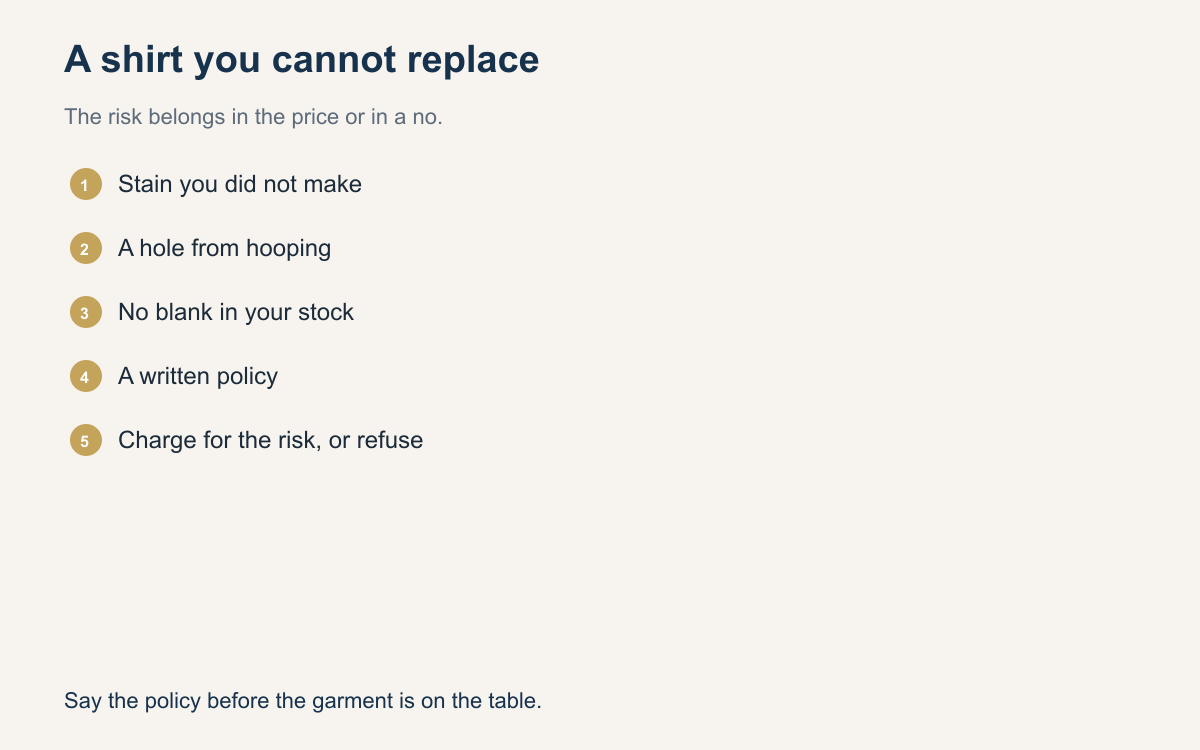
Customer-supplied garments look like pure profit because you did not buy the blank. Then the shirt arrives with a stain, or the sew fails, and there is no second shirt on your shelf. The sewing fee might be 15 dollars. The jacket might be 80 or 200, and it might be the only one they own. You are now responsible, in their mind, for a garment you cannot replace. That is not a favor. That is an upside-down risk.
You have two clean options. Charge for the risk, with a written policy, or refuse the job. A verbal "I will be careful" is not a policy. The dollars below are an illustration you should rewrite to match your shop. The sentences are the part to steal, and even those should sound like you when you say them out loud.
What you are actually taking on
Three problems show up over and over. Stains and holes were already there, and without photos they become yours. A bad sew-out has no replacement, because you do not stock that blank. And the sentimental price of a vintage piece or a gift is higher than the sewing fee, which you cannot pay. Skill does not remove that. A puckered knit or a hoop burn can happen on a careful day. The policy is for that day.
A written policy you can reuse
Use a short policy and make them agree before you hoop. Inspect every supplied garment at the counter. Photograph stains, holes, and weak fabric, and say what you see while they are still standing there. Mark those notes on the order. Ask for a signature, even one line, that the marks were already there. You do not guarantee a supplied garment against hoop burn, needle cuts, or a design the fabric cannot hold. If the sew fails, you refund the sewing fee. You do not replace the garment.
Add a handling and risk fee on top of the sewing. In this illustration it is 8 dollars a piece, or 10 on outerwear. It pays for the inspection, the photos, and the fact that a failure has no spare. Raise it if the jackets in front of you are worth far more. The refund rule is the real shield. The fee is what makes you do the inspection every time.
What you refuse even for a fee
A fee does not make a reckless job safe. Refuse leather you have not tested, very thin performance shirts, beaded or sequined fronts, anything with no flat area to hoop, and any piece the customer says cannot be replaced. Say it as a category, not as an insult to this one shirt. "I do not sew garments that cannot be replaced, and I do not sew fabrics I have not already tested on a blank I own." You can offer to sew the design on a blank you supply instead. That is a better job for both of you, because a mistake has a spare.
If you want a stricter shop, refuse the whole category. "I only embroider garments I supply" is a complete sentence. You do not owe anyone a custom path through your risk. Shops that only sew their own blanks have a boring, profitable problem: the spare is on the shelf and the cost is on the invoice. You can adopt that rule tomorrow. You do not have to grandfather every bag of shirts already sitting in the corner. Finish what you already accepted under the old handshake, and use the written rule on the next person through the door.
- Inspect at the counter, not after they leave.
- Photograph stains, holes, and thin fabric while the customer is present.
- Get a signature that those marks were already there.
- If the sew fails, refund the sewing fee and do not replace the garment.
- Handling and risk fee, illustration: 8 dollars a piece, or 10 on outerwear.
- Refuse leather you have not tested and thin performance wear you do not trust.
- Refuse beading, sequins, and pieces with no flat hoop area.
- Refuse anything the customer says cannot be replaced.
- Offer a blank you supply when the brought-in piece is the wrong risk.
- You may also refuse supplied goods entirely. That is a full policy, not a mood.
How to say it
Say this before you take the bag, then tune the fee: "I can sew on garments you bring if I inspect them first. I photograph any stain or damage that is already there. There is a handling fee of 8 dollars a piece on top of the embroidery. If the fabric will not take the stitch, I will not sew it. If a sew fails, I refund the embroidery charge and I do not replace the garment, because I cannot buy that exact piece." Put those words on the order form. If they will not sign, you do not hoop.
Schedule them so they do not wreck the day
A supplied shirt in the middle of a cap run costs a hoop change. Batch those jobs onto one morning, or add labor minutes on top of the 8 dollar illustration. The fee is for risk and inspection. The hoop change is labor. If you refund more sewing fees in a month than the risk fees brought in, raise the fee or shorten the list of what you accept.
Decide this week whether you sew supplied garments at all. If you do, print the inspection, the photos, the signature, the refund rule, and a risk fee, and use them on the next bag through the door. If you do not, practice the one sentence that says you only sew blanks you supply. Either path stops the quiet losses. The expensive path is the handshake, the careful promise, and the shirt you cannot replace.
A question for the group
What is your written rule for customer supplied garments, and which items will you refuse even if the customer offers to pay extra?