
Pricing
Are you undercharging for embroidery?
A sew price that only covers machine time can hide a loss. Count the blank, the backing, the thread, the minutes, the hoop and trim, a new digitize, overhead, and the profit you meant to keep. Then replace the sample numbers with your own.
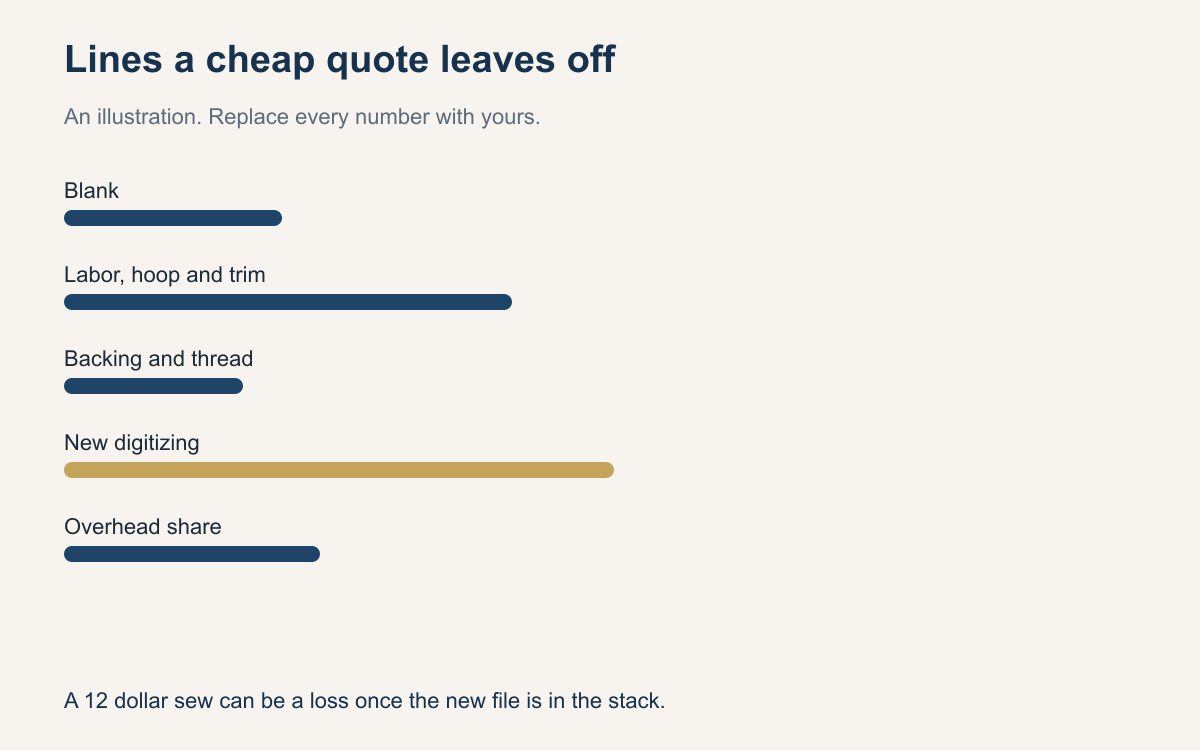
Undercharging does not feel like undercharging while you are busy. The machine is running, the customer said yes, and the number you quoted is the number shops around you seem to use. Then the week ends and the money that should be left is not there. The missing part is usually a cost you never wrote down, not a customer who beat you up on price. You agreed to a sew price and then did a pile of other work for free.
You find out by counting the whole job, once, on a real order, with your numbers. Not a national average. Not the price a group said they charge. The stack below is an illustration with round numbers so you can see the shape of a loss. It is not a price list, and it is not what you should charge. Replace every figure with what you pay and what you need to keep.
Start with the blank, the backing, and the thread
The blank is either your money or theirs. If you buy the polo, that price goes in the stack. If the customer sends the shirt, write zero so you remember you are selling labor and materials. Backing and thread are small and real. A cutaway and a topping cost money on every piece, and a dense left chest uses more thread than a name. Guessing zero is how a cheap sew stays cheap only on paper.
You do not need a scale on day one. You need an honest round number. Put one dollar on a normal left chest and two dollars on a heavy cap until you measure it. Stop pretending materials are free because they are smaller than the labor. Small lines on every order are a large line by Friday.
Count machine minutes, then hoop and trim
Machine minutes are the easy part to see and the easy part to undercount. A file that sews in four minutes is not a four minute job. Someone hooped the shirt, aligned the mark, watched the head, trimmed the backing, clipped the jumps, and checked the piece. On a simple left chest, many shops find the hands-on time closer to fifteen minutes once hoop and trim are included. If you only priced the four minutes the machine moved, you donated the other eleven.
Time a real piece with a clock. Start when the shirt comes off the shelf and stop when it is acceptable. Include the re-hoop. Do this for a left chest, a cap, and a back, because they do not share a time. If fifteen minutes has to pay a wage, the sew price has to contain those fifteen minutes.
A new digitize is part of this order
If the design is new, somebody digitizes it or edits a trace into a file you can sew. That work is not included in the stitch count. A returning file that you already trust can carry a small or zero digitize line. A new logo cannot. Shops eat this cost to win the first order, then the customer never reorders, and the file fee is gone. If you sew the new design once, the digitize belongs on that one invoice. If you sew it fifty times, you can spread it. You cannot spread it across shirts that were never ordered.
Put a number on the edit too. Auto-digitizing did not make the file free. A person still checks underlay, density, type size, and the blank. Charging nothing for a new file can be a choice you make on purpose. It should not be a choice you make because the line was missing. Write the digitize down even if you later cut it.
Overhead and a profit target
Overhead is rent, the machine payment, needles, power, and the rest, sliced across the jobs that have to pay for them. If the shop costs a known amount each month and you sew a known number of hours, put a round number on each hour. A few dollars on a single left chest is a normal result. Zero is not.
Profit is what you meant to keep after the costs, not whatever happens to remain. Put a target on the piece before you quote. A few dollars on a single shirt is enough to name. A quote that covers every cost and then adds nothing pays everyone except the shop.
An illustration, not a price
Here is one illustration with round numbers, not your price and not a survey. A customer sends one polo and a new left-chest logo, and it is tempting to call it a 12 dollar sew. Blank, zero, because they sent the shirt. Backing and thread, 1 dollar. Hands-on time, 15 minutes, at 1 dollar a minute, so labor is 15 dollars. A new digitize, 20 dollars. Overhead, 3 dollars. Profit you wanted, 5 dollars.
Add it. 1 plus 15 plus 20 plus 3 plus 5 is 44 dollars on a single new logo, against a 12 dollar sew. That 12 dollar job is a loss once the 15 minutes of labor and the new digitize are in the stack. On 20 shirts the digitize falls to about 1 dollar each and the job changes shape. These are round numbers, not a price. Replace every one of them with your own. Do not borrow 44, and do not borrow 12.
What to change after you count
If the stack is higher than the quote, raise the price, simplify the file, or set a minimum on single new designs. Accepting a loss is allowed when you can say why, such as a sample that leads to a reorder you already priced. Volume does not fix a job that loses money one shirt at a time.
Count your last ten invoices, not a fantasy order. Separate new files from repeats, and caps from left chests. One category is usually fine and one is quietly paying for the rest. Fix the quiet one. Tell the customer when the price includes a new file, and that a reorder is different.
- Write the blank at cost, or at zero if the customer supplies it.
- Add backing and thread.
- Time machine minutes plus hoop and trim.
- Add a digitize line when the design is new.
- Add an overhead number you can explain.
- Name a profit target before you quote.
- Replace every sample number with your own.
- Price a new one-off logo differently from a reorder.
Count the blank, the backing, the thread, the machine minutes, the hoop and trim, a new digitize, overhead, and a profit target. The 12 dollar left chest is a warning about shape, not a fee. Fifteen minutes of labor plus a new file can turn that sew into a loss. Put your numbers in the stack before the next quote.
A question for the group
Which line were you leaving off your price, and what did the job look like once you put that line back?